Check out #LibEvangelism to hear other people's experiences of the day, and lots of great quotes from the speakers.
Showing posts with label event. Show all posts
Showing posts with label event. Show all posts
Sunday, 3 February 2019

Monday, 8 January 2018
Monday, 6 November 2017
Friday, 24 February 2017
Video: Gabriel Three and Leicester
Check out this post to see what Gabriel Collective is.
Gabriel Three vlog: London 10th December - Christmas
Gabriel Leicester vlog: Leicester 4th February - Love
Saturday, 28 January 2017
Towards Ordained Ministry course: Session One
A few nights ago I went to the first session of the London
Diocese’s ‘Towards Ordained Ministry’ course. DDOs and college chaplains in the
diocese refer candidates and potential candidates to this every year; it is another
tool within the resources for discernment, but it lies in that in-between world
of not quite being BAP prep but also being more intentional and sure than initial
exploration events. Talks are based on the vows in the Ordinal
in the context of ‘Pursuing your Vocation in the Diocese of London’.
This is how they put it:
“Here is a great opportunity
-to explore and learn more of your vocation to the ordained
ministry
-to get to know others from different traditions than your
own
-to hear speakers who themselves have been along this road
-to share in discussion and prayer”
I’ve got to be honest, it’s the first time I’ve felt positive
about the Diocese’ vocation resources; it’s such a shame that they don’t manage
to support people earlier in the process as well as this course supports people who
are further along.

Anyway, the first session was a corker. The theme was Authority,
based on the vow to “accept the discipline of this Church and give due respect
to those in authority” and we were honoured to be addressed by The Rt Revd and
Rt Hon Dr Richard
Chartres, outgoing Bishop of London.
All my experiences of Bishop Richard – my
confirmation, a drinks reception at his residence, several Easter Vigil
services at St Paul’s – have confirmed his reputation as a wise and caring yet
competent man, and this session was no exception. It was a privilege to hear
him speak, with eloquence, wisdom and humility, and a smattering of humour, as
well as get a chance to talk to him in the relaxed mingling beforehand. He
asked where I had come from and when I said St Martin’s, his follow-up was “Ah,
which part of the empire?” which shows you a little of our reputation within
the city.
I knew one other pastoral assistant there, from our Area PA support group, and he and I chatted with three girls sitting next to us, two
from slightly higher
churches and one from a very much lower church.
He spoke for about an hour, so I’m going to just summarise
my notes, but I didn’t write everything down, just the things that struck me,
though hopefully I’ll be able to convey a flavour of his talk.
--
In his introduction, he talked of balancing a need to ‘listen
profoundly to colleagues’ whilst also being aware of the danger that ‘heavy
structure’ (like endless committees) can be a huge ‘energy drainer’.
1.

His talk was then structured in three parts. The first was
the root of being ‘one holy, catholic, and apostolic church’, and the importance
of the Church of England’s identity as part of its authority. We have never denied that there are other
parts of the ‘1HCAC’ and often, if not quite adapted to, at least encouraged local
expression of faith (subtext being: remember we’re not Catholics, homogenising
and exclusivist).
Ecumenism is now framed in a context of looking forward to
the ‘great and coming’ church of the Kingdom, but the CofE has the privilege of
being able to reach in any direction and touch the whole spectrum of ‘church’.
One of my favourite points he made was that the clergy must
not just be collaborative, but instead ‘conjunctive’, not just making joint-efforts
but genuinely joining and combining. Because we are fundamentally and
intentionally not sectarian, we must look for allies in the mission on the ‘shared
passion’ simply for the Lord Jesus Christ.
2.
An ‘assent on worship’. This was an interesting section
which touched on the fundamental difference between Christian and Muslim understandings
of God. Whilst in Islam they submit to a Supreme Will, Christians reach out to
an Almighty Love. The key is the transforming truth of the Trinity, for our
communion is not static but dynamic, as God’s true nature is. From ‘Adam where
are you?’ through ‘Samuel! Samuel!’ through ‘Mary!’ to the climax of the
Incarnation itself, it is into dynamic relationship that we are called. Bishop Richard advocated the
BCP as a ‘balanced and simple diet of scripture-based worship’...
3.
…which led nicely into the authority of scripture and the creeds.
A wonderful phrase he used about
scripture was the importance of ‘hearing the
whole symphony’ rather than extracting ‘bleeding gobbets’ to rely on and 'bash each other over the head' with. ‘Spacious
inhabiting of scripture’ is important, within a ‘community of interpretation’. Crucially
this includes the writers of the Creeds, that though long-dead, using the Creeds
is a way of reading scripture not just with our contemporaries but also our predecessors,
who deserve as much respectful deep listening as anyone alive now. This leads us into being able to, as Common Worship puts it ‘proclaim
[the faith] afresh in each generation’. Bishop Richard emphasised the importance of
having a presence on modern platforms, and inhabiting the ‘territory of the 92%’
ie. the population of London that does not engage in Christianity. He advocated
creativity as crucial to success in this.
This leads us into being able to, as Common Worship puts it ‘proclaim
[the faith] afresh in each generation’. Bishop Richard emphasised the importance of
having a presence on modern platforms, and inhabiting the ‘territory of the 92%’
ie. the population of London that does not engage in Christianity. He advocated
creativity as crucial to success in this.
After his talk, there was a time for questions. The first
was ‘When did you discover your vocation?’ and his immediate response was ‘After
I was ordained’. He explained that it was only once he was a deacon working in
a parish that he found his vocation in doing the ‘ordinary work and being
admitted to the tragedy behind every face’. He also pointed out that it was
necessary to have healthy distance between the role and your own person – do not
assimilate.
He also returned to ecumenism, which he said works when we
look to the whole community and as conjunctive allies, looking in that same
direction together. He warned of the trouble in the future (that we will
inherit as the next generation of clergy) and condemned schism as ‘obstinately
metaphysical’ especially in the context that for the under 30s, church is becoming
‘post-denominational’. He went on to lament the ‘ignorance of Christian grammar’
in the country.
--
Future sessions will be:
- The Bible - Do you accept the holy Scriptures as revealing all things necessary for
eternal salvation through faith in Jesus Christ?
- Doctrine - Do you believe the doctrine of the Christian
faith as the Church of England has received it, and in your ministry will you
expound and teach it?
- Ministry - Will you be a faithful servant in the
household of God, after the example of Christ, who came not to be served but to
serve?
- Spirituality - Will you be diligent in prayer, in reading holy
Scripture, and in all studies that will deepen your faith, and fit you to bear
witness to the truth of the Gospel?
- Mission - Will you lead Christ’s people in proclaiming
his glorious gospel, so that the good news of salvation may be heard in every
place?
Friday, 9 December 2016
What's the purpose of my being a priest?
In January, 11 months ago, I wrote this post about my existential crisis 'is being a priest what I was born to do', how will I know if I've succeeded at life, and should I try and plan my life with goals to achieve?
Since then I have surrendered to God, plus started the discernment process which will hopefully lead to a conclusive answer to the question of my calling. But these last few months working at St Martin's, I've begun to be plagued by questions going beyond whether I'm meant to be a priest.
If the answer's yes (of which I am convinced) then what is the purpose of 'Rev. Georgina'? This person in my future, who is she called to serve? Basically, as the kitty says:

So even though I swore off vocations events, a few women from the SMITF congregation were going to London Calling: Young Women, so I went along as a veteran to support them. It was a great event, and I actually got a few things from it.
These sort of things have been stewing in me as I contemplate how to be who I am for other people, and what that might look like once I'm a priest. I'm not expecting to figure it out any time soon. I've spent the last 10 years figuring out who I am and what a priest is and how those two go together; if I get recommended to training, I'll be spending 6-7 years figuring out what's beyond that.
The question has been asked and the process has begun, and of course it's not ultimately down to me - God will take me through it and revelation will happen when all is in place and ready. I know that; this isn't me trying to set out a career plan. This is me realising that having accepted who I'm meant to be, and whilst the Church are deciding whether they agree, I should start contemplating why I'm supposed to be a priest.
What am I meant to do with it? What am I meant to do with all the blessings and opportunities I've been given? What's it all for? What does God want me to do once I am a priest? What's my purpose?
Since then I have surrendered to God, plus started the discernment process which will hopefully lead to a conclusive answer to the question of my calling. But these last few months working at St Martin's, I've begun to be plagued by questions going beyond whether I'm meant to be a priest.
If the answer's yes (of which I am convinced) then what is the purpose of 'Rev. Georgina'? This person in my future, who is she called to serve? Basically, as the kitty says:
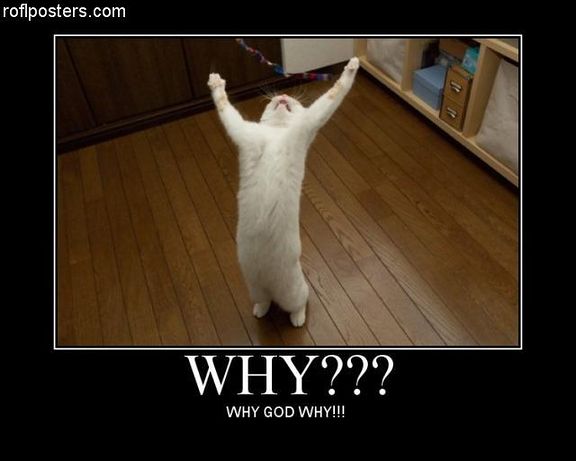
So even though I swore off vocations events, a few women from the SMITF congregation were going to London Calling: Young Women, so I went along as a veteran to support them. It was a great event, and I actually got a few things from it.
- Liz Adekunle, the Archdeacon of Hackney, was pretty cool, and she used the phrase about women priests being "used creatively" which was the first thing I wrote down, as it struck a chord.
- The chaplains Julia Candy and Natalie Garnett spoke of being a 'point of contact with God' and "letting people know they're precious".
- Carys Walsh said that mission and evangelism means "enabling the people of God".
These sort of things have been stewing in me as I contemplate how to be who I am for other people, and what that might look like once I'm a priest. I'm not expecting to figure it out any time soon. I've spent the last 10 years figuring out who I am and what a priest is and how those two go together; if I get recommended to training, I'll be spending 6-7 years figuring out what's beyond that.
The question has been asked and the process has begun, and of course it's not ultimately down to me - God will take me through it and revelation will happen when all is in place and ready. I know that; this isn't me trying to set out a career plan. This is me realising that having accepted who I'm meant to be, and whilst the Church are deciding whether they agree, I should start contemplating why I'm supposed to be a priest.
What am I meant to do with it? What am I meant to do with all the blessings and opportunities I've been given? What's it all for? What does God want me to do once I am a priest? What's my purpose?
Subscribe to:
Posts (Atom)