My goodness look, she’s put up a text post, huzzah! I know,
I know, I’ve been a bit lazy and just put up videos for a while.
But in the wake of my first term as an ordinand, I don’t
think I can reflect coherently on how I am and how things are in a video. It’s
been a packed 11 weeks, busier than I anticipated. I’ve needed to be easy on
myself, and not get guilty about the things that I’ve felt I haven’t done well.
I didn’t know what to expect going in. I didn’t know how to
organise myself with an academic degree – ‘doing some reading’, lecture notes,
the library, ‘pre-reading’. Foreign territory, all of it. And since my last post about the retreat, we’ve had several deadlines for essays, which has been
the real meat of the term, academically speaking. I was totally unprepared for
that, and I’ve learnt a lot of lessons which will hopefully mean next term will
be better.
Amongst that I’ve been struggling the sustain myself
spiritually and socially, plus not been able to do exercise, and I even had to
give up cooking in the last few weeks, and only eat in the dining hall. I ended
up in a bit of a heap by the end. But I feel overall positive about the whole
thing, which seems odd, but like I said, I’m being easy on myself. My first
term of nine may not have been smooth but there were no disasters, nothing
actually ‘went wrong’, and I’m still happy to be where I am.
I’m making friends, getting good marks back from the essays,
getting on with my housemates, connecting with various clergy in the area. I’ve
been on placement with a great chaplain and I’ve even given a sermon! I had
visitors from the south a couple of weekends, there was a fantastic Christmas
party to finish term and say goodbye to the deputy warden – trying to summarise
the whole term is pretty tricky, but there are tons of positives.
But life has been very full. I have felt a little dragged
along with it, getting on with things when I didn’t understand them 100%, didn’t
have time to get to grips with them as fully as I would have liked, which for
me is a stressful place to be in. I’ve not really acknowledged my underlying
stress, and I should. I’m not ‘stressed out’ but I just have not felt grounded.
My tutor pointed out that one factor is not really having a
lot of contact with my home ground kind of church – I’m spending most of my
time at either much lower, at college, or higher, at my placement chapel; and I
think she’s right that it’s had an impact. I was at St James’ on Sunday for the
morning service and Nine Lessons and Carols, and there was a relief to be with
people ‘like me’. Now I realise that this is partly an evolutionary hang up
that we really must get over, but that doesn’t stop me feeling that way.
At least I have actually enjoyed building relationships with
evangelicals and conservatives at college, even if it’s been an effort. And it’s
not been as bad as it could have been, because said evangelicals have been very
open; the way I put it is they may think I’m going to hell, but if they do they
don’t seem to hold it against me.
Like I said, hopefully I’ll have more of a handle on my
academic work next term, which means I can schedule in down time, exercise,
socialising, and other stress release things. Plus some of this term’s stress
sources should be a lot less stressful because I’m now more familiar with
everything new, and I'll start seeing a spiritual director.
So, first term as an ordinand. Overall positive, lessons
learned, hopeful in moving forward. God is with me.
PS How AWESOME that the new Bishop of London, my sponsoring bishop, is a woman!!
PPS watch out for my next adventure - I'm flying to Switzerland next week!
I would have uploaded this ASAP but our college house has not had working Wifi so I write to you now from a week into being here at Cranmer Hall, Durham.
As you can probably tell from the title of this post, I'm not really very relaxed about being an ordinand. It's still weird, and scary, and unbelievable, after such a long time getting here, actually being here doesn't feel like it should be happening. Surely there's another hoop to go through? Surely I'm not truly ready to claim the title 'ordinand'.
The implications of coming to train are vast and varied, and the thought that I am actually going to be a priest is only one. New city, new house, reduced money situation, being away from my friends, taking all the opportunities available to me, being a student again, living with other people again - it's been exhausting dealing with it all at once. I'm lucky that I've moved a lot over the last few years, so the move is less dramatic, but there's still an emotional wrench of moving from the south east to the north east, with a different rhythm to the city, learning to find my way around, not living on my own any more, not using public transport every day...oh, and the temperature. I am a delicate English rose, and working out how much clothing I need every day, investing in thermal underwear, and finding out where nearby sells electric blankets, all makes for a tad more stress.
I've already fallen down in my self-care. I failed to remember how I know I operate, that I need intimacy with God, with close friends, and with myself, to balance my mental health into a good state. Plus this week has involved a lot of meeting people, forgetting their names, and working out which ones will be more work to get on with than others, which is a drain even on an outgoing extrovert like yours truly. So I had a slightly emotional night last night, which I am in the process of remedying, so no harm done. But lesson learned, the hard way.
We've had introductory talks, a prayer day in the cathedral, a day of lectures from a world expert on Thomas Cranmer, a college freshers' fair (I signed onto the mailing lists of LGBT+ Soc, FemSoc, and the theatre society), many cups of tea in the common room, and matriculation when I was thrilled to have my first outing in a cassock and used my cloak to boot.
A lot of the induction this week has been like any other university - like the police officer telling us not to take drugs, and the fireman telling us not the cover our smoke alarms with clingfilm - just with more Christianity, and advice/info being spoken into our proto-clergy situation, like the dual nature of our focus, that our academia is merely half of our time here, and our spiritual lives take as much precedence. This of course echoes ministry, giving us good practice.
I will be honest, the academic side terrifies me. I was pretty good at school work, though not essays, and this is my first degree to do 'proper' essays, as opposed to the self-reflective ones from my previous degree. Doing reading, spending time in the library, it's all alien and I'm not confident in my own ability to do very well.
At least I'm on the way to making friends here. The house is finally settled, with only an ice cube tray to source (for the gin and tonics you understand). I like the fact that I have an uphill 15 minute walk to college everyday, and morning prayer to do, evening worship to join as well. I've managed to arrange a space in my room for my prayer stool, so I can kneel in front of my small standing cross. I'm being good with my diet, taking heed of the warnings against 'the Cranmer stone'. I'm also damn pleased to have my comfy armchair in the living room!
Blimey. I am an ordinand. We'll see how this goes.
On Saturday 23rd April, I went to Coventry Cathedral for a young women's vocation's conference. There were 87 young women attending and about 20 ordained and lay women organisers, with a handful of husbands helping! It was the first all-women event I've been to, and I was having flashbacks to my school days at a girls school.
I videoed a quick summary of my thoughts as I waited in the train station, and below is a run down of what we did, and the notes I took during the sessions.
I had train issues but still managed to get there in time (go contingency time!) and we were welcomed before sharing in morning prayer. Celtic morning prayer, which was cool (I recently book the Celtic Daily Prayer book, which I'm looking forward to using). The first key note was Bishop Anne talking about vocation as a woman.
Notes from the welcome:
- under 40 and especially under 30 women under-represented as priests
- feeling of sisterhood! Surrounded by others, all have a story
Notes from the first key note
- God's voice is richer for being the living Word as opposed to human words
- what does God trust me with? Trust me to do?
- courage - embrace pain and joy, the risk of trusting the next step
- phrase 'anunciation moment' [useful to describe my moment in September]
- have sense of the potential of who I can be in God
- children and ministy = careful planning
- lifetime of discerning God's call that weaves in and out of the tapestry of our lives [this was an overriding theme and a really good analogy, such as only being able to see the mess at the back rather than the picture God is weaving on the front]
- women reject job descriptions if they don't think they can do 10% of it
- trust God through fear, like fear that you're on the wrong path - you can't fall beyond the reach of God's will and God's love
After a tea break, the second key note was basically a session on how to defend when someone brings up arguments against the ordination of women. I gotta be honest, I started getting uncomfortable at this stage, and realised that being at a targeted event about vocation may be great for young women who might not otherwise look at themselves as potential priests because of their gender, but I did not have that problem. It also rankled that a) I was basically being defined primarily by my gender which is an attitude I don't tolerate in my life and b) it played into the system of the gender binary, which is itself a factor in the patriarchal systems of female oppression, as well as just out of date thinking that I reject.
But speaker Lis did use the phrase 'the Gender Agenda' and sadly, people do have an agenda based on repressing the female gender. I made notes, and it was, I suppose, useful to hear positive interpretations of scripture, but I'm making the decision not to put them here, as a statement of my belief that we need to get past this position of defense; it was needed 20 years ago, but my generation is putting gender aside. It is not relevant to judging my aptitude at ministry, and as much as I love my gender and am proud to be a woman, I will not even give the space for the possibility of argument any more. It is finished.
I enjoyed talking to the young woman who I ended up sitting next to for the morning, but at lunch talked to others who migrated to the appropriate seating area designated by geography (ie south, south east etc). But sadly, because there were so many of us, and we weren't really pushed to stay in one area and talk to the same people, I spent most of the day feeling a tad isolated, and didn't bond with anyone the way I had at all the other, smaller, events I've been to.
Like in Kettering and York, we took seats at tables, and stayed there for most of the sessions, and lunch, which meant we had motivation to get to know our neighbours. Without the anchoring of a consistent place, I was really lucky to talk to anyone, and even luckier that I bumped into the woman I sat next to in the morning, at the train station, which was great.
After lunch, we split into smaller groups to attend short seminars that we had picked in advance. My first was 'Young and Ordained' and two women, a new curate, and a vicar, introduced themselves, told their stories, and asked us to talk to the person next to us about a person in the Bible that we related to.
My notes from this first half:
- hard to leave settled life - calling is not static, God 'sends'
- ordination is not peak of calling
- I related to Peter; the start and end of his calling by Jesus 'Follow me' and 'Do you love me?' - that's what Jesus is saying to me too
- but what can I, and only I, do in answer?
Then they talked about the challenges and joys of ordination.
Challenges
- 'Wisdom beyond your years' - expectation that clergy know what to say. Not necessarily 'the right quote', 'the right psalm' - no formula. God gives us words, just be yourself.
- 'Making and maintaining friendships' - friends spread out as you move around, especially young people move more. Be intentional - use holiday, make effort to go and to host. Who is important to make time to see?
- 'People taking you seriously' - not as bad as you might expect. Blagging it so people feel calm and reassured. People expect to see a representative of God. God equips.
- 'What people expect of the Vicar' - afraid to tell vicar that they [the vicar] are wrong as the priest should know. Can be asked about ethical and moral decisions.
- 'Being true to yourself' - look like self in dog collar. At first very aware of the collar. Feel judged. Alright to have friends in the parish. Rise to the challenge and adapt. Blurred lines especially for ordained with big personalities [!!] in different situations. Still forming in 20s/30s, getting to know yourself now in a public space.
Joys
- meet lots of different people
- feel right place, time and doing. Not what people expect lead to opening conversations.
Straight into the next seminar, it was really great to have sessions on other callings that parochial ministry, but uniquely in my experience led by actual practitioners of those other callings. I listened to three chaplains talk about school, prison and university chaplaincy.
Notes:
- spontaneous, holy spirit-led ministry
- broad, in every sector
- "religious/spiritual care in an organisation"
- finding God at work
- can volunteer to get experience, go through vicar or DDO
- multi-faith model, for the world
- creative, opportunities
- round peg, square hole in parochial ministry
- God also calls to stop
- drop in income doesn't matter if happy in position
- not imagine self in parish
- [thought to self, could there be an LGBT chaplain, rather than a place chaplain?]
- chaplains are on the edge
- prison - intense and emotionally demanding
- large capacity to love, love those otehrs would find difficult, and can't loveselves
- gift of love to loveless place, and bring hope that anyone's broken life can have meaning
- structured expectations - visit new prisoners within 24hrs, visit segregated, visit hospital
- paid by prison service, but critical friend eg on policy
- uni - students have less baggage
- Christian community
- wider community - all faiths and none, generous
- element of mission but not priority
- religious literacy - prepare students for a world that is 85% people of faith
- 'friar' in community [I like this image]
- "be you, there"
- school - welcome and hospitality, mental health
- resources for worship
- put on services for organisation
- "be a good guest"
- not of the organisation whilst in it
- talk to anyone, full access
- earn trust and show integrity
- lovely, a privilege
- transience, let people go
- listening
Bumped into a familiar face from CPAS!
More tea and coffee, then a final session for a panel Q&A.
Notes:
- have to be recommended by vicar
- know where you could engage the debates, and where you can't - trust each other to be under scripture and under God, and walk together in prayer
- mental health difficult in church context
- at first, revisit feelings of incompetency
- it will cost for family
- look at all college options - not straightforward - what experience do you want, needs in academic theology, time, community, tradition, somewhere you can come alive
- official discernment process comes under Equality Act
- call is complicated - follow and obey but also life does happen and can change course - God works through strange ways
- husbands not so hot on clergy spouse support as wives - careful of boundaries with your spouse - are they called to be part of ministry
- take ordination vows seriously eg obedience - can be part of the Church's own discernment - Issue of Human Sexuality "content to live within these guidelines" - have to accept to be put forward for ordination
- BAP - vulnerability of being 100% convinced whilst also knowing that you're coming into the possibility of being told you're wrong
After one more cup of tea, we have a lovely Eucharist, and as I said, I had a lovely chat with one of the other attendees at the train station, just after I filmed the video.
On March 11th 2016 I had my long awaited chat with a military chaplain. Early as it is in my process, I have a leaning towards chaplaincy; I have been looking at the various options, and out of the big ones (hospital, prison, university, military) for an unknown reason military has pinged on my radar.
I expressed this to my rector back in the mists of time (November) when we had a few meetings about my calling, and she happened to be working on a study guide to a memoir written by a priest who she had met at a conference, who was a military chaplain. So she e-introduced me to her, and I set up a meeting. This was back in January, and we met in March because she lives way out West and only comes to London occasionally.
It was a really nice conversation over a cup of tea. I told her my story of faith and calling (see the first handful of posts on this blog) and she told me about her calling, and then about chaplaincy. A lot of what she said sounded great and really like something I could do and enjoy, and she affirmed a lot of what I said in return.
She was encouraging and said I could email her any time, and she told me a lot about military chaplaincy that I didn't know. I'm trying to keep an open mind and really look at chaplaincy as a whole at this early stage, but nothing she said really put me off. Luckily I probably have at least nine years until I have to start contemplating chaplaincy and job prospects more seriously.
-
-
As weird, embarrassing, and scary as telling people about my calling is (especially clergy) it is by far one of the most productive exercises that helps me understand myself better, gain new insights, and use their feedback and perspective in my own understanding of what God is asking me to do, and how to go about it. It also makes it a lot more personal, less abstract, and is very encouraging, I suppose because it becomes that little bit more tangible, more realistic. It is also always a great relief when no one laughs and tells me the thought of me as a priest is ridiculous.
It's most exciting (and least embarrassing) when the specific purpose of the discussion is specifically for me and my calling. It's hard not to feel egotistical when talking about it in more casual, social conversation. I've stopped talking about it with some people in my life, just because I feel bad for going on about it.
That's one of the many reasons I'm looking forward to being referred to a member of the diocese vocations team; their role is to help me, so I won't feel bad about focusing on my calling when talking to them. I also got another reminder today that I should really get a spiritual director - it's on my to do list, and if I remember, I plan to ask for recommendations from the ADO or whoever I talk to.
In reference to the video, this is what I wrote this morning:
"At the moment I'm in the middle of reading the book Jesus and Peter: Growing in friendship with God. I've wanted to get to know more about Peter for a while, and this is the book my rector recommended. I've always liked Peter, but it was this past Palm Sunday that it started niggling at me, because I played the part in our dramatic performance of the Passion story. (Yes, our church doesn't care about casting historically accurate genders in it's dramas - the point of dramatising the story is to make it more affecting, and seeing your pew neighbour up there denying Christ, betraying Christ, or being Christ makes it very effective, regardless of the gender they are.) Thinking about Peter as I stood next to the person playing Jesus, it struck me, I think for the first time, how real the people in the gospel stories were."
Will ya just calm down Peter?!
I thought about this when standing with the friend I mention in the video; thought of Peter standing next to his friend Jesus just I was standing next to my friend, and both our friends handing out wisdom and trying to calm us down.
Peter in the gospel is a passionate, hell for leather kind of guy. Good intentions, not so much forethought, rushing in confidently but often crashing around a bit. I can SO relate. Calm, helpful Jesus would probably have had conversations similar to the one my friend had with me, getting Peter to slow down enough to think.
I suspect Peter probably had times when he felt overwhelmed and torn as well, trying to balance talking to Jesus, praying, checking with the others, getting supplies, sorting the money, scheduling the travel plans, keeping all the Jewish needs seen to, eating and drinking right, staying out of the sun when it was hot, keeping up with the news locally and from other cities, maybe even contemplating romance, possibly having medical issues, enjoying getting a tad drunk sometimes, doing a heck of a lot of walking, thinking about his fishing days and missing his dad...Anyway.
Just like I talked about Paul in another vlog, Peter had his period of stumbling, but both men became pillars and leaders in the early church, in Acts. I read the outcome of the their stories and think "Oh I want to get there too! How?!" and the answer is the same as for them: through Jesus. Simple and complex at the same time. At the moment, I have Peter's enthusiasm and Paul's clouded vision. My relationship with Jesus and our journey together mirrors theirs as well - through prayer and community; and their example in the NT's pages gives me courage to keep going.
The book about Peter talks of 'mature discipleship'. That's a great phrase for how I see my calling, the end goal, whether that be in the form of ordination or not. I'm like Paul, without Peter's advantage of being the same spacetime as Jesus the incarnation - my relationship is with the ascended Christ, the Son of the Trinity. So my discipleship is not following him around for three years and sorting his travel arrangements. It's moving towards him in prayer, centering my life on his example, and helping others do the same, bringing humanity closer to the coming of the kingdom of heaven.
He will meet me in prayer, and in community. And very much in the meeting of souls when I talk to my friends. Jesus for me is my friend, the person at my shoulder, often with a warm, comforting, rock solid hand on my shoulder, giving me the strength with the Spirit, wisdom from the Word, and a guiding, if not always obviously, path from the Father.
I hope I can get somewhere with the second one. It's so ingrained in me, such learnt behaviour, such an integral part of my vocabulary. And like I said, the other options like crumbs, goodness, oh shucks, sound so crappy, they aren't attractive alternatives.
Bible should be interesting in bigger chunks than usual readings. Here come all those "begats"...
Doubt is not something I want to put words to. Admitting that I have doubts about my calling is quite painful. But doubt is an important part of faith. I don't think a lot of people really realise that. I know for example I've had an argument with my boyfriend about the nature of faith - he thought is was something you feel and not based on evidence. I countered that he was describing blind faith, and I did not recognise his definition as the faith I have.
Faith is not always blind
Blind faith is 100% convinced, but true faith has real conviction because it constantly doubts. Why have faith in something if you haven't reason to? I have doubted pretty much every part of my faith, including the big ones like do I believe in God. I like going back to the very Jewish idea, which I think Anglicanism embraces very well, of arguing. Arguing with your faith, interrogating your scripture, contemplating other possibilities. Moses (Exodus 4) immediately springs to mind as someone who directly shouted at God, questioned God (Exodus 3), and in the New Testment, the Apostle Peter wavered in faith (Matt 14); even Jesus had moments, eg. at the Mount of Olives (Luke 22), and I considered not even mentioning Doubting Thomas as the obvious choice.
These doubters were all true role models of faith. And so I feel stronger for being able to follow their example, and speak out about my doubts, to face them head on, in the never-ending struggle and journey of faith.
***
I have worried that I am deluded. Most of the time it makes so much sense to think that I am 'destined' to be a priest, then I scold myself for being so arrogant, then I worry that not feeling special is a sign that it's not a true calling, but surely modesty is better than self-grandeur...
It gets a little cyclical, and I end up feeling lost and guilty. Okay, so confront it, what if I am deluded? (Forgetting the possibility of being deluded that there is a God, and concentrating on the possibility of being deluded that I feel a calling from God). I have been getting more and more religious, so is thinking there's a calling just part of my very thorough way of doing things and being a priest seems the obvious way of 'doing religion thoroughly', and that's the real reason I'm doing it? Does it feel right because it feels like the way to do that part of my life 'properly'?
Okay, I might have a calling, but what if I'm called to something else? Being ordained and being a full time priest is just one of many callings for Christians. I might be copping out of the hard reality of juggling Christianity and other parts of my life. Many people, most Christians in fact, live out their faith whilst in full time secular employment, why do I feel I have to put my Christianity as not just my religion but my job, and not just that but a community role, a life vocation?
Surely I'm not the right person to represent the Church and lead an example of Christ-like living. I've never been naturally a 'people person', and a lot of people find me too loud, boisterous, direct and intense. I have very liberal attitudes to things like sex and relationships that many in the Church would probably object to, even though I go about my love life with as much care to Love God as much as Love Neighbour as any other part of my life. But part of me worries that I'm just wrong. I think I'm doing good not evil, that I'm living conscientiously, trying to not sin, but what if I'm wrong? I swear, take Christ's name in vain, get drunk, shout at my family, buy nice things, don't give change to beggars. There are people in the world who genuinely think I'm a bad person; there's at least one I can think of who probably actually hates me. That doesn't sound like a priest.
No one seems as enthusiastic about it as me. Is their support just politeness? There's a lot in the literature about other people affirming your calling - nope. One crazy stranger, that's all I've had. Not my priest, my boyfriend, my family, my friends, no one has positively said they think it's a good idea. I'm not trying to criticise them - if that's how they feel, I certainly want them to be honest. So if they are, if I'm in the minority of one that thinks I could be a priest, how likely is it that I'm the one that's right?
I have no issues with my human sexuality
Let's look at the Criteria again (see also previous post) and what I can't do or haven't got.
Others have not confirmed my inner conviction.
I have barely any spirituality; I generally never sit in prayer to God apart from reading other people's words. Nor have I done any Bible study. I don't see how the world and others have been affected my practice of prayer, and frankly I have serious issues with the notion of 'the power of prayer'. I've never understood how spiritual practice 'sustains and energises'.
I've struggled with maintaining appropriateness in professional relationships - I'm a flirt, blunt, emotional. I'm an out bisexual - whoops, Issues of Human Sexuality.
People don't follow me, my leadership skills leave a lot to be desired. How can I offer an example of faith when I feel culturally compelled to not mention God so as not to make atheists uncomfortable?
I feel anger and fear about mission, a distinct mistrust and aversion to evangelising.
***
So what do I doubt about my calling? I doubt that I'm called at all, I doubt that I'm called specifically to be ordained, I doubt that I'm the right type of person to be ordained, I doubt that I'm right to disagree with my support network, I doubt that I can fit the criteria for being ordained.
And it is terrifying. I hate having doubts. I have so much conviction, assurance and excitement about my calling, it knocks at my core to express doubt. I've used this metaphor before: I have a bedrock of trust in God, on which are pillars of faith, holding up the foundations of my soul, on which the building of my heart sits, in the infusing cloud of my brain. Doubt is lightning spearing from that cloud, and rocking the whole structure. My emotions get knocked about and chaotic, my soul ripples and sends shockwaves through my faith, and my trust is holding firm but not unwobbled.
My first step was talking to my rector age 19 (see previous post). My sense of calling died down again to just a niggle for the future. A classic discernment question is "Where is your calling? What does it feel like?" I always said it was at the back of my head, in a corner, and it was just a gentle, constant prodding, a soft poking.
My job as a freelance stage manager is very precarious but I have been either skilled or lucky (I'm not sure which) that from leaving college at the end of my degree July 2014, I have been in constant work as a stage manager. The life of a new graduate involves a lot of applications, CVs and cover letters, and for a new graduate freelancer, whose contracts are usually between 5 and 9 weeks, that process continues once you start getting jobs, to book in the next one, and the one after that.
I had a series of jobs with a week or less between them, always having the next one booked in before the end of the current. I did have a low bar for what I applied for, so I applied for a lot; I'm going to be open and honest here and say that I was extremely lucky that I was always able to fall back on my parents if it came to it, so I occasionally took low paid jobs and my dad supplemented my income, to support my career. Again, I realise that I am a Very Very Lucky girl.
After a year, I decided to become more specific in my goals, applying for jobs that paid a minimum I could live on, and only in the roles I preferred. This narrowed my number of applications down considerably, and unsurprisingly, the offers dried up completely. I got to the end of the last job I had booked in with nothing to follow and moved back to my parents in their little village, away from London, at the start of September 2015.
Two weeks. I was unemployed for two weeks, and I went a little mad. After a week, I lowered my bar again for what I applied for, but started making lists of things to do, hobbies to take up, skills to learn. Having not been in that position before, it ate at me immediately. Yes, this is middle class pathetic-ness, but this is my story, I can only tell it honestly. And with made up words like pathetic-ness.
One of the items on my many lists was to start writing again. I used to be a prolific story writer, doing things like NaNoWriMo, but my inspiration/leisure time had dried up. I sat down with pad and pencil, old school to get myself into the mood, and wrote a few pages of a scene, a girl in a church service, a young professional (sound familiar?)
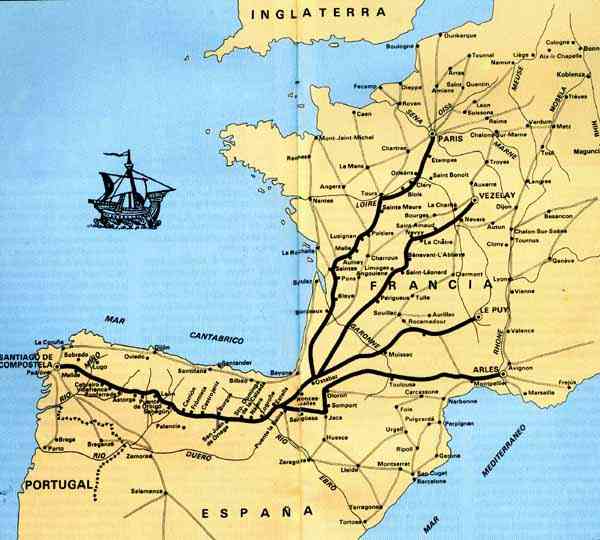
A few days later, I sat down to expand on this scene a create a character, a world, a plot. This took me on a research rabbit hole, and I started developing the idea that this girl could take a sort of gap year to explore her faith - visit Iona and Taize, go on a silent retreat, that sort of thing, culminating in doing the Camino di Santiago, something close to my own heart as we have a group at church called the Camino group, as it is also known as the The Way of St James.
Abruptly, I looked at the mind map I was creating and realised it wasn't fiction I was writing - it was a wish list. I looked up how long to the Camino took and got it in my head that a lot of people did about six weeks, and suddenly, with my unemployed future stretching out in front of me like an empty void, I thought "I could do that." Excitement gripped me as the reality of that thought sunk in, but rather than booking flights and getting my rucksack out, I went through all the usual vocation websites that I had gone through several times - CallWaiting, CPAS, LondonCallings (my church's diocese vocation page), CofeE Vocations - then calmed down a little and wrote another email to my rector, subject: "Adrift...again."
Could I arrange with [the parish secretary] a time to have another chat with you about vocation and looking into the discernment process?
I talked to my best friend, the one I met at sixth form, my parents, my boyfriend. By the time my appointment with the rector came around, it was on the same day as two interviews for jobs starting at the end of September that I had applied for before this massive kick from my calling. When asked again where it was, the niggle had moved and grown, and now felt like a pervading presence covering the top of my mind, a presence over everything in my life.
That meeting was mixed for me. She probed me to get an understanding of my position, which at that moment was a bit dramatic, wanting to give up stage management and concentrate on following my calling, under the continuing delusion I mentioned in this post. I just felt a sense of urgency but I didn't want to make a big deal, a "look at me, I'm special" statement, nor did I have any idea what the next step was, except maybe there was someone who's job it was to deal with people like me in the diocese and I needed my rector to put me in touch with them.
She was very supportive and encouraging that we needed to keep the momentum up and explore that I was feeling. We booked in another appointment that was sadly cancelled when I got offered one of the jobs I interviewed for, the schedule for which meant we didn't have any free time in common until a month later, and I went off wondering if she was taking me seriously. In hindsight, I didn't give her much to go on and she probably rightly assessed that I needed to do my own digging to come up with what I wanted to do next rather than just giving me options like I wanted to, because it needs to be a slow process. I have moments where I'm chomping at the bit, angry even that I have put up with continuing this stage management career whilst my want to make this other thing me priority.
But I have done some digging, like finding this amazing Guide to CofE Discernment, and done a few other things, and I've gained some perspective. More on that, and my second meeting with the rector, in my next post.
Now it is a reasonable hour of the day, as opposed to the dead of night like my first post, I'm going to set out a few more details of who I am, and my faith journey so far, to give a bit of background to where I am now.
Who am I? From a secular point of view, I grew up in a rural village in a middle class county in the south of England, with my mum, dad, and younger brother. I was schooled at a private girls school and a mixed state sixth form, spent a gap year first on work experience then travelling (see this blog) and I realised I was bisexual age 14 (see another blog. You can see I like blogging). I went to drama school to do a degree in stage management, and I have been working in the theatre industry in London as a freelance stage manager since August 2014, so for just over a year as I type. This in itself was a vocation that I wanted to do since I was 15, but I have since realised that it was a step within my greater vocation ie. my calling to ministry.
Anyway, I'm getting ahead of myself. My mother is an atheist and my father is a non-practising pluralist. It wasn't that I grew up without God or being told God didn't exist, God just wasn't mentioned. I was baptised, but my parents really did it for social and cultural reasons. But my uncle gave us various children's Bibles so I had one as my favourite book for a while as a young child, without any real understanding of the stories as 'scripture'.
When I was 6, I spent two years at a Church of England primary school, so I learnt the Lord's prayer, said grace at lunchtime, sat through assemblies given by the local minister, and went to church twice a year, Harvest and Christingles services. I didn't like Harvest because it was at the really modern URC church (we had an ecumenical partnership in our village) but Christingles was in the tiny, ancient parish church that backed onto the fields. My love affair with the church started in those services, dark and cold but lit by candlelight with the magic of Christmas in the air, with the bonus of being trusted with open flame, and sweets of course. I'd blast out Shine Jesus Shine in the same way others my age sang the latest chart toppers or Disney tunes, and even when I left the school age 8, my dad took me each year for the next decade.
Consciously engaging with Christianity as a philosophy began in my Religious Studies classes at my new school. When I was about 12, my teacher answered a girl's question about what she personally as a Baptist thought counted to be Christian. She said if someone believed Jesus Christ was the Son of the one God, and he lived, died and was resurrected to save us from our sins, everything else was arbitrary, and even the how/why of those statements was up for debate. I looked down at the textbook on Christianity on my desk and realised I have thought of myself as a Christian since primary school but never thought about what I believed. It was more of a cultural default, part of being British. But I knew in that moment I did believe those two statements, so for the next years of school, I digested and dissected the different beliefs and practices of the different churches and navigated my own belief system.
When I was almost 14, I started noticing a girl around school who had a crucifix necklace, and I
On holiday after starting to wear
a cross. I still have that one.
asked for a cross necklace for my birthday (ie. one without a figure on it). I've worn a cross around my neck at all times since, nine years so far, and I've amassed a collection of different styles.
It was at sixth form, age 16, I met a girl who would become my best friend, who had grown up in a Church of England household, so knew a lot more about community worship. I knew the theory of worship styles, but had yet to find the motivation to go to a Sunday service or become involved in a congregation. So we would have discussions about our shared but basically very different religions, and she took me to one Sunday service in our two years studying for our A-Levels, as well as helping me pick out a Bible, which I had never actually thought about buying before, oddly.
On my gap year trip, I started going to church. It happened quite naturally, almost incidentally. My work experience had been with a Christian theatre group on tour, so I had had a little go at being with other Christians, like church-lite, but one day in a town called 1770 on the Australian coast, I went to a Sunday service and every week after that I googled the local Anglican wherever I woke up on the Sunday morning. I also picked up a devotional so I read that and the readings from my Bible, which I took with me, every day for a couple of months until it ran out.
Moving to London, one of my priorities was finding a church where I could throw myself in and really go for it. Having spent years working on my personal faith, time for some community faith. [This is a view I have gained retrospectively. At the time, none of it seemed liked the steady step by step progression it was.] I had met the associate rector of St James' Piccadilly in New Zealand, and I went along a few months after starting uni, and fell deeper in love. I could go on and on about St James', but for the purposes of this blog, the main things that SJP has done are: I go to church every week, I'm a reader, server, alto in the choir; I run the youth discussion group, gave a talk at the general discussion group. run the LGBT group including marching in the Pride parade with the Christians, do the tea and coffee after the service once a month; and I was confirmed in St Paul's Cathedral.
IN SUMMARY
6yr I went to Christingles
12yr I turned to Christ
14yr I wore a cross
18yr I went to church
19yr I found my church
21yr I got confirmed
I'll cover the last two years of my life in my next post. See you then!