Showing posts with label spiritual gifts. Show all posts

Thursday, 9 June 2016

My new job as Pastoral Assistant


(So yes, as I announced in my last post, I got the job that I mentioned in this post - in the video I talk about it 1:45 til 4:40 - I'm going to assume you've watched that and read the post.)

In September, I am going to start as pastoral assistant at St Martin-in-the-Fields, a CofE church on Trafalgar Square, of high worship style, liberal theology, and a great culture of enterprise to get out and help people. It's known for it's charity The Connection at St Martin's, as well as it's Vicar's Relief Fund and almost a century of Christmas Appeals with BBC Radio 4. They also have popular cafes in the Crypt and the Courtyard, and occasionally celebrity/royal events.

The church also has a fantastic music programme, with concerts for free at lunchtime, or by candlelight in the evening, masterclasses, jazz nights, and six in-house choirs. Every time I've been to any service, the first thing I tell people when they ask about it is "well, the music was incredible!" I don't know if I'll be able to join any of the choirs, but I really want to if I can!

I have specific duties in my role in children's ministry, liturgy, and pastoral care; and in general my role will be assisting the clergy, working with all the staff, and experiencing the breadth of the church's work. The job very much has a mutually beneficial dynamic - the PA is a team member who is part of the running of the church's work, but is also there to experience ministry with an eye to going further into it.

As I mentioned in the video, there was some discussion on whether I would be sponsored in discernment through SJP not SMITF, as they have more often sponsored their PAs themselves. As far as I'm aware, it's all okay for me to carry on with St James', so that's good.

I was so nervous before the interview. As I said in the video, I had a gut reaction to this job, and I wanted it BADLY. I've never been so nervous. If I had fucked up and not got it, I really didn't know what I would do - it seemed inconceivable that I would continue being a stage manager. It just made perfect sense that this opportunity came at exactly this moment, but unlike other perfect opportunities in my journey of faith and vocation, this was not just something I had to take. Other people decided whether I could take it.

This has been my first experience of human gate keepers in following my calling from God, and it wasn't pleasant. I had to remain realistic throughout, and whilst I kept a hope and faith alive that what I felt was right would be my path, it ultimately lay in the hands of others, and there was a chance they would say no. That is the same scenario I will encounter at every stage of the official discernment process and this preview has shown me, by gum, it's going to be hard.

But anyway, I did get it. After four days without news, I was so stressed I just upped and walked out the house and stomped out to the fields, and sat on a bench by the river, sighing, crying, and staring into the distance, like I was in an Austen novel, minus lacy hanky. I eventually rang them, but got the answer machine. Despondent, I started back home, and as I walked up church lane, they rang me back. When the good news was imparted, I stopped in my tracks and literally bent over, leaning on my knees, in utter relief. When we finished speaking, I hung up, and thew my hands in the air with an almighty "YEEEESS!" bellowed into the sleepy quiet of the village. When I got back, I told my parents and burst into tears.

I am over the moon. It's going to be an amazing job that I will enjoy, get a lot out of, and also be pretty good at. Only yesterday a friend was congratulating me on managing get paid to spend the majority of my time doing something I love ie being at church! But more seriously, the job is going to put a lot of stuff that I've only thought about in theory to the test ie. ministerial qualities and skills that I need to be a priest - do I have them? We shall see. It's going to be doing ministry, watching clergy at close quarters to see how they do it, be backstage and involved in the liturgy in a depth I just didn't have access to as a lay volunteer, and getting to grips with what it takes to run a church.

To sum up, here's an extract from my application statement:

"I have been involved with various vocations events, like day conferences, and weekends away, as well as attending a variety of services within the Anglican tradition, and going on retreat on Holy Island; but discussing and sharing conversations about my faith, my calling, and myself can only go so far in the exploration of vocation. Actually doing it is the best way to work out how one operates and what one’s gifts are; the difference I saw between talking about being a stage manager and being one at college was tremendous, only overtaken by the difference between training on the job, and doing the job as a professional!

Also being part of a prayerful worship community full-time is a unique context in which to encounter, respond to, and connect with God. I suspect there will be developments in my relationship with God that would only be possible in the opportunity of being a pastoral assistant. The role of service is an integral part of finding freedom in God."

Thursday, 17 March 2016

Video: Step Forward 2016


Step Forward is the Church of England's big annual conference day for people aged 18-30 considering ordination. It was held this year on March 12th (last Saturday as I write) at Bishopthorpe Palace outside York. The Archbishop of York was supposed to attend but was called away.
Entrance hall

The programme looked like this:

10:30 Registration and Refreshments
11.00 Opening Worship – Preacher: the Rt. Revd. Alison White, Bishop of Hull
11:30 “Calling”
12:15 “Discerning” Break into diocesan groups to meet Diocesan Directors of Ordinands (DDOs) and hear about discernment process.
13:00 Lunch
13:45 “Forming” A chance to hear what training is like (with Mark Tanner, Warden of Cranmer Hall, Durham and Father Peter Allen, College of the Resurrection, Mirfield, West Yorkshire.
14:30 “Serving” Stories from a variety of people serving as ordained ministers in very diverse settings.
15:30 “Worshipping” Closing worship including sermon, and opportunity to receive prayer, laying on of hands and anointing.
16:00 Tea and Depart

"Calling" was spent in partners doing some exercises to explore/describe our calling. We filled in a worksheet with 'stepping stones'  to lay out the major steps on our faith journey up to now. Mine looked like this:
  • Part One (age 0-13) Children's Bible - Christingles - The Lord's Prayer - Mrs Currie - Do I believe this?
  • Part Two (age 14-19) I want to wear a cross - You should own a Bible - St Michael le Belfry - I'm going to church tomorrow
  • Part Three (age 19-23) I'm home - I want to get confirmed - Singing with God - I'm going to end up being a priest - Psalm 143:8 - I think I'm going to be a chaplain
(details in my blog posts first, second, third and fourth).

The steps in bold are the ones I think are the biggest turning points, and what I originally put in the five stones on the sheet before drawing in a million other ones to fit the other points of the journey. Then we did a classic discernment exercise called SHAPE - CPAS have a great online tool to do this exercise here. I've done this in the past, but as the leader pointed out, it's good to go over and see if anything new pops up. Mine looked like:

Spiritual gifts - Mercy and forgiveness, Faith, Hospitality
Heart - Doing right; Understanding and creating understanding; Storytelling
Abilities - Communication, Organisation, Energy
Personality - Confident, Generous, Focus, Love, Cheer, Honesty, Passion
Experience - Stage management; Sixth Form graduation Student of the Year; Different churches in Oz/NZ

Next we looked through God calling in scripture, and I connected with three - Jeremiah 1:4-9 "I am too young"; Peter in John 21:15-19 "Do you love me?"; and Paul in Acts 9:1-22 because he was blinded by his call (obviously I have only been metaphorically blinded).
Window in the main conference room

"Discerning" was great, mostly because I haven't met a DDO yet, and hearing the process from their perspective was really interesting, plus it was a lot more comfortable grilling them knowing they weren't your own DDO.

After lunch was "Forming", which was definitely my favourite part. Introducing themselves as a 'double act', the heads of the two theological colleges gave two very inspiring talks, not about grades, essays and course structure, but about the nature of the formation that goes alongside the academia, the spiritual and personal development that, at a more fundamental level, makes a priest a priest. Notes I made during this bit were:
  • hold the presence of Christ in the church and in the world
    • non-negotiable icons of Christ
    • burden of non-stop priesthood
  • learn who I am, who God is, and to be attentive
  • Both in the world and in God's world
  • Become the person I didn't think I could be, incl. a theologian, and a person who can pray
  • Imperfections can lead to positive surprises
  • Live from within my heart
Gives me goosebumps just reading it back.

Lastly was "Serving", the stories of four priests is different circumstances about their work. It wasn't the most diverse group - a catholic, male, village curate; a young, female, rural curate; a female, village vicar; and a male urban vicar - but I supposed it's always interesting hearing different stories.

Another note that I don't remember where it came from says simply "There is a cost to following the love of Christ." I think it might have been the urban vicar or the female, village vicar.

Two to-do things I got out of the day were arranging some chaplaincy 'placements' or whatever experience I can get, and be a calmer person, which will take more time and effort than the former task!

Overall it was a really lovely day with really interesting, inspiring and lovely people. I got to talk with Bishop Alison over lunch, and empathise with other delegates over the terrible state of online vocation resources, or at least the difficulty in finding them. They also gave out contact details of DDOs so I now know who the London DDO is and who the Two Cities Area Director of Ordinands is, who I presume will be involved in my case, when it finally gets that far.

I had dinner at the pub with these two lovely delegates
-
-

On that point, the rector said last Friday we could set up a meeting, so that'll hopefully happen after Easter next week. I've put up the quick vlog I did about meeting with the uni chaplain today - as I said in that, I'm meeting another uni chaplain, and a uni college/police chaplain next week, and hoping to meet with a prison chaplain as well, though that's not bearing fruit as yet. They're being very nice and helpful, I've only contacted them this week and already filling the diary. I'm going to shadow the guy I talked to today for a day in April!

Next week will be great, being Holy Week. Sadly because I'm not living in London, I won't be going to the daily reflections, but I'll go to Maundy Thursday, and the Three Hours Good Friday which is always one of my favouites. I don't know when I'll get into London on Easter Saturday; I normally go to the St Paul's Cathedral service but that might be a pipe dream. I'll at least end up at church for Compline and the over night vigil; there'll be a dawn service (which is also one of my favourite), then Mum and Dad are bringing American guests to Easter Sunday, and some of us 'youth' going to the pub in the evening for the young people's monthly group, because sod organising a session at the end of all that. I'll sing at all the services, including the audience-participation-flashmob Hallelujah Chorus from Handel's Messiah, which is always fun! Including trumpet, obvs.

I'll stop rambling now. Future blogposts plan is I'll write something about my meeting with the military chaplain separately, and finally get round to answering the questions that came out of the CPAS conference day.

Saturday, 27 February 2016

Video: LifeCall - a CPAS day conference on Young Vocations


NOTES FROM THE DAY
  • It is fundamental to call others to God.
  • All disciples are called to serve God; secondary calling is what I'm called to in particular. And my calling is not 'ordained ministry', it's more specific than that
  • college as an ordinand - formation and academia. Discern with fellow ordinands
  • show potential for growth and development
  • encourage others and nurture their gifts
  • the ministry of an ordained priest is to focus, enable, equip and release others
  • "Being at home in God"
  • setting boundaries that are unnatural to an extrovert
  • the complexity of the CofE is in its diverse experiences
  • one foot in the world is important
  • Sacrifices of the ordained - strained/unsure/complicated boundaries, not being able to switch off, loneliness, others' perception, not being able to put down roots
  • the theological understanding 'ordination' is debated and contested. It's a moment of consecration, that can be viewed on a wide spectrum from sacramental to just authorisation for a function. It is at a base level an affirmation by the church
  • there could be opportunity to do work experience in a chaplaincy
  • military chaplaincy is a niche calling and so should be explored
  • my deeper understanding of myself can summed in
    • morality
    • supporting passions
    • understanding and providing tools to help others understand
TO DO
  • ask others what my spiritual gifts are
Art at Christ the King, Kettering.
"Whoever claims to live in him must walk as Jesus did." 1 John 2:6

QUESTIONS FOR ME TO ANSWER (in another blog post)
  • Am I willing to submit to God's will if it's not ordination?
  • What is my leadership style?
  • What is my heart's desire?
  • What are my motivations?
  • How has God used me already?
  • What is the way God calls me?
    • OPPORTUNITY right step at right time, with a feeling to back it up
  • What is the Gospel to me?
  • How do I know when it is God talking?
  • What is the church here for?
Emma from CPAS, me, and Jenny the Cranmer ordinand. Great gals!

Monday, 14 December 2015

What my experience as a stage manager can bring to being a priest

This is a helpful little exercise I've decided to set myself as I'm vaguely aware that there are a lot of transferable skills and experiences, but I've never done a thorough run down. It's certainly from a secular angle, tackling the part of being a priest that is actually 'a job'. So here goes:

The big one is Relationships. Reading the Summary of Criteria 'relationships' section is very similar to reading a realistic job description for a stage manager. In SM, you're biggest responsibility is your relationships, and being the central force to establish and sustain cohesive working relationships, creating boundaries, and maintaining a professional standard, whilst also being the department that provides the pastoral care. Stage managers are the ones company members come to with any problem, and that often can include things not related to the show. It becomes habit - "I have a problem: I'll go to the stage manager." The ability to be inclusive within diversity is paramount as well, as the theatre is full of more varied selection of people than outsiders might think - a stage manager cannot reject any of them, even the really annoying ones, or the ones who can't do their jobs (as much as we would sometimes like to).

The next biggest one is Stress or Pressure. The responsibility of a stage manager is broad and deep,
with little things and big things of wildly different sorts all coming under their remit - the prop pencils on the set desk have to be arranged just so, and also the company time sheets have to be cataloged; make the coffee, and also coordinate the timetable to accommodate every single department's needs. Often needing to be in three places at once, doing a lot of running around the building/city, coming in first and leaving last, being expected to be in charge of facilitating everyone else's ideas in time, to budget, often without much help. All with the other expectation that you are the cheery one, the calm one, the one that knows everything that's going on even (though no one seems to bother to tell you anything), the one everyone can rely to put in the extra effort, and achieve miracles out of nothing.

Piggy in the middle AKA the SM department
I like to call one of the traits of stage management Translation, and I think this applies to being a priest as well. It means being a radial point from which vastly different spokes connect for the one interconnecting reason or goal, and therefore needing to know exactly what each spoke wants, how it operates, what it needs out of the other spokes, how to get that, and most importantly, how to translate the one's needs into the other's language so they can coordinate.

Linked that idea is involvement in Negotiation/Conflict. Your spokes, even with you translating, can push against each other, and as the radial point, it is your job to put the reason/goal for working together first, often reminding them of it - the stage manager is the person who puts the show and the humanity of the people involved first, helping everyone compromise to achieve their shared goal (once they've remembered what that was) and do what is best for that goal and each other, rather than letting ulterior motives, or petty issues of pride dictate the company's choices.

A little bit of blasphemy...
How does one achieve that? Change and Flexibility. Being able to speak the language includes adapting to each spoke's needs. But also on different shows, the lighting spoke on this show might be very different to the lighting spoke on the last show eg style, people, resources. The stage manager has to still hit all the criteria, but that can look very different when you have more direct people, less people, no money, rather than people who 'play the game', loads of people, and a bit more money (it is never enough money...). How I interact with my line manager or my director has looked vastly different show-to-show, based on the sort of people they are and the show we're doing.


It comes down to Facilitating, Collaborating, and Communicating.

At least on the outside...


So what sort of characteristics does a stage manager need? I'm going to copy and paste from the Criteria again. Mature and Stable - there are enough egos, motivations, dreams, emotions and mental states to deal with and manage, without the person who's supposed to coordinate them adding to the complicated mix. Stage managers are relied upon, by dint of being stage management, to keep calm. It is the stage management department that in practical terms, has 'being the grown ups' as part of the job description. That also means having an exterior support network that you can rely on when you need time to be your own person, so as not to lose you humanity. You have dreams and emotions and the rest of it too, so it's important to have people in your life you can express those to, when most of your time is spent putting them aside for the sake of others.

Another thing that a company will rely on is the Integrity, the Trustworthy-ness of its stage management. It's that putting the humanity of people first thing again, and going back to the acceptance of all, rejection of none motif. If you go to your stage manager with a problem, as part of their role as problem solvers, the importance of trusting their judgement, and also knowing that you won't be judged yourself, is paramount for that vulnerable relationship to function.

This links in with the element of Leadership. SMs have 'manager' in their titles, even the assistants. I find this one quite challenging, as I've never been a person people naturally follow. Enough words have been written on the characteristics of leadership without me adding much to them, but for an SM, or a priest, it is a leadership through serving, ultimately. You make decisions, give advice, lay down the law occasionally, but when you get down to it, we are doing all we can to improve the lives of the flocks we have committed to minister to with everything we have in us, and bring about a creation, a world where all are happy, their dreams have come true, and (S)He's purpose for us all has been brought about. (People in my life have realised that I may tell an anecdote and mention someone known only as 'He' or 'She', and they've worked out that the only person it can be is the director of whatever show I am currently working on, as often, making them happy becomes the centre of my life, and their pronouns are therefore capitalised).


And of course you want to be the cool guy that everyone likes.


The last parallel I'll draw is the element of Lifestyle and Vocation. Okay, so no one gets a 'calling' to be a stage manager, but it is still a vocation in the secular sense. You're not just taking on a job, it's a whole life. You're schedule is precarious, often overloaded and changed last minute. Don't even try and have a sleep pattern. And the diet goes out the window. It sounds like priests often have a similar diet to stage managers on those days when a 'lunch break' or 'dinner' are basically out of the question - microwave meals, a quick sandwich in between or even during meetings, and phrases like "I haven't eaten since breakfast" lose their drama when echoed more than 3 days in every 7. There's an unwritten, unspoken expectation of 24/7 service, and as much as we know we should carve out private lives and personal time, and even rest once in a while, we often find ourselves checking the email, taking the call, or agreeing to do just a little more, because that's not just what we do; it's who we are.

Tuesday, 1 December 2015

Song as Worship and Prayer

I never liked singing in choirs. I tried it at senior school but I didn't like singing the high soprano part but also didn't like not singing the tune on the alto part. So I decided I didn't like choirs and protested all efforts at sixth form to get me back in.

So a few months into being at St James's Piccadilly, I had been enjoying the sung Eucharist. I had previously had a few years of singing lessons, and always privately sung musical theatre and Disney tunes in my bedroom. But it was only then, singing every week, that my love of singing reared up and made itself known as an important tool for worship, so I turned up to a choir practice. It's not really a choir - it's the Lay Singers, with no audition, or even any ability to sing or turn up, required.

Without the pressure of expectation, and with some long-time choristers to cling to as I battled to find my alto line, I got over my dislike of not singing the tune, and actually started to a) sing chorally and b) improve. I realised my voice really suits traditional church music, and the hour before the service rehearsing with the lay singers in the church hall became and still is one of the most fun parts about being at church.

I also started to appreciate how much I connected with the music spiritually. Singing the Kyrie eleison was much more evocative for me than saying it. I well up every time I sing the various heart-wrenching arrangements of the Agnes Dei. If I get a sore throat, I feel like I've had a limb cut off.

The moment that really pinned down for me the connection to God we make when we sing was on the 16th of November 2014. A few months earlier, the cantor at St James' had come to me with a proposition. She, like any other employee, had holidays, which included a number of Sunday mornings thought out the year. I had seen this in action - she booked someone else to cover her, sometimes a professional church singer, sometimes a tenor from the Lay Singers. Her proposition was that I could cantor with the tenor, as a little duo, with the intent of preparing me to do it on my own.

Yeah, just stand at the front and lead the singing *gulp*

I was thrilled and honoured by the opportunity and the responsibility, but it was also a terrifying thought. There's normally 100 people minimum in the congregation at the 11am service; it's a big church for one voice to fill without a mic; I'm only an amateur singer; and lots of regulars are likely to notice if you forget something or do it differently (ie f*ck up).

It went fine of course, and we did a little duet as the anthem over communion. The main thing I was worried about was the blocking, there's even a couple of spins the cantor has to do as part of the gospel procession, but there was no tripping or going the wrong way. Sigh of relief.

I started to do it on my own, and with more frequency, as it was easier to book me rather than an outside professional. I still got paid the fee though, which was an unexpected bonus.

I have grown to love cantoring. It's such lovely music to sing, and it's great fun singing stuff I know and can do well, loudly and proudly. But mostly, I love leading, providing something for people to use in their worship. My favourite comments are not that I sang well, but those occasions when people tell me it really helped them connect, eliciting an emotional, spiritual response.

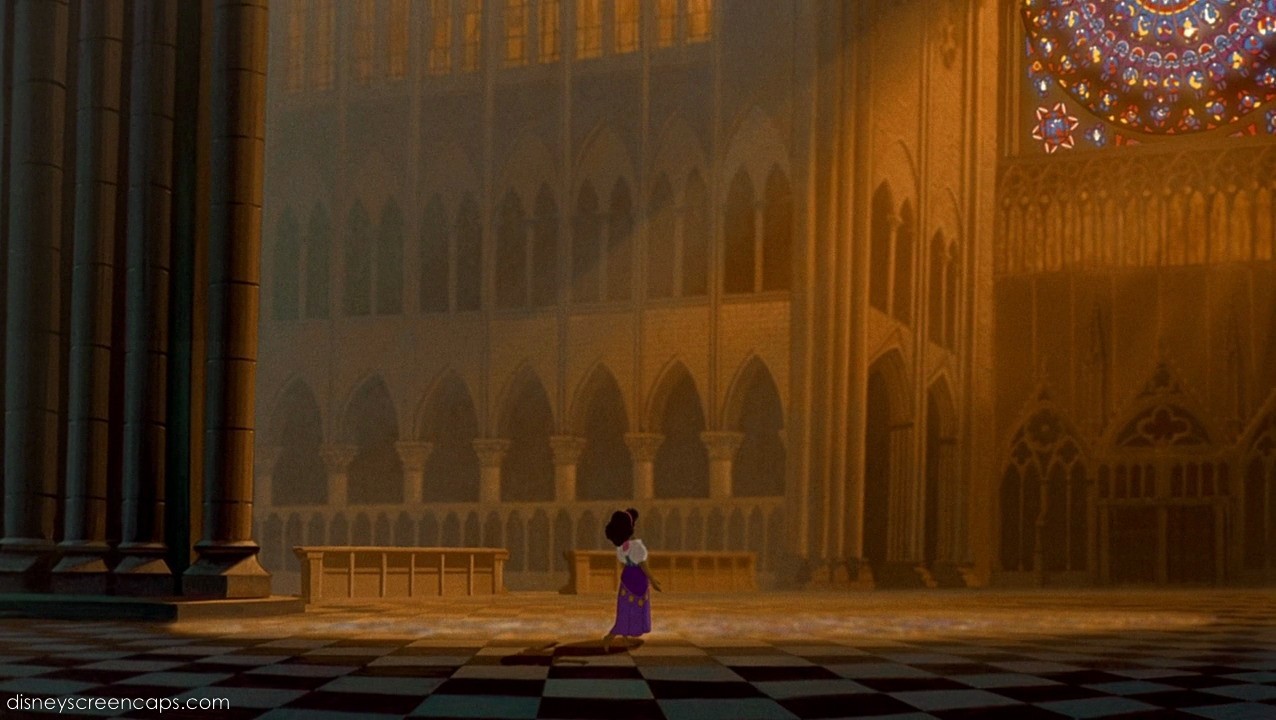
Esmeralda also also sang to God.
I didn't have the Rose Window to inspire me, but still

So, as I mentioned, part of cantoring involves doing an anthem, a piece of music whilst the congregation is taking communion, and I can't lead a choir, so I do solos and duets.

On the 16th Nov '14, I did a solo for the first time. I was nervous, but I knew I had practised thoroughly. The organ started the introduction and I forced myself to relax, forget about the people listening, and concentrate on the music. I started singing and the familiar notes calmed me further. I realised the building's acoustics were enhancing my voice and I listened as well as sang. As I started the final verse, I was filled with a great sense of joy. I lifted up on the notes and felt like I was shining with bright light. I was singing to God, I was singing with God!

It was such a beautiful moment. My time at St James' has an interlocked path of progress for my faith and my singing. It is my favourite and greatest expression of my faith and the love of God.

And now, a kitten.

Thursday, 19 November 2015

Wednesday, 18 November 2015

What does a lay person want out of a priest?

So this post comes as part of my response to the Criteria, details here. As I said in that blog post, I want a list of what I think makes a good priest whilst I still write from the perspective of a lay person, so that I won't forget, or dismiss it as I go further down the path looking at it from the Church's point of view.

These are the characteristics I think are expected in a priest. But let's be clear that this does not mean I assume they will always be met. Laity should never hold priests up against a scale of perfection, as they are flawed human beings as well.

Decency
The first attribute that comes to mind is I want to know a priest is a good person. Not a perfect person but it should be a defining characteristic that they are a positive force in the world. I want to be be able to be confident that a priest has good intentions, never dominated by anything selfish or destructive.
Being wise doesn't need an armchair
but is does help the image!

Wisdom
This one's an odd one, but I have to admit that there is an expectation that a priest is a resource for
perspective, comfort and guidance. It is a lot to ask, but it comes with the position of authority within a spiritual context. I don't mean I think they should have all the answers. But there is an assumed level of knowledge of the wisdom of generations before us - ie. Church tradition and philosophy - that should influence their reactions and contributions.

Effort and reliability
Now, I don't want this to be a paragraph about self-sacrifice, but I think a priest needs to put the effort in. They have to try. Laity should be able to rely on the clergy to put effort in where others might give into the temptation not to, and sometimes that will include going the extra mile. It's not the same as other jobs where you can get away with 'doing the minimum'; it doesn't work like that. Clergy are human beings, they have a right to down time, and a personal life, but that has to come with an understanding that you can't be off the clock - you're never again be not ordained.

Being there
Again a bit odd, but when I say I think part of being priest is just being there, I mean exactly that. I suppose it ties in with the previous paragraph. There's an element of presence, a go-to place that is accessible. It's like when I set up my uni's first LGBT+ society - we didn't actually do much the two years I was running it, but constant feedback was an appreciation that it was there at all.

Be approachable, but maybe not as
creepy as Buddy Christ here.
Approach-ability
I started going to church on a regular basis whilst travelling, and a classic part of visiting a new church on a Sunday morning is being able to go up to the clergy afterwards and have a little chat. It's hard to go up to new people and introduce yourself, to try and engage with a community, but there should be a higher level of comfort going up to a priest, a confidence that they will happy to talk to you, interested in why you're there, and maybe even a gateway into being introduced to regulars, lay congregation members who are less intimidating once the priest has broken through that barrier for you.
And just branching out, it's the same for clergy who aren't parish priests. Chaplains, missionaries, 'pioneer ministers', deacons, cathedral staff, bishops even, teachers, diocese staff - there is a responsibility that goes with being ordained, in whatever capacity you operate in, to be open to engaging with those who approach. Basically, you have a lot less leeway before you are being rude or flaky.

Patience and tolerance
Priests minster to people, and people come in all sorts of varieties, and many are not all that great. Humanity can be dull, irritating, rude, opinionated, loud, obnoxious, snooty, the list goes on and on. The key is not having to somehow achieve a truly open heart and manage never to be irritated or bored etc; priests are people and sometimes people rub each other the wrong way. No, having more genuine tolerance is helpful to be fair, but patience is basically exercising tolerance, even if it's not there. Priest can't act intolerant, whether or not they are finding it difficult to tolerate somebody. Embodying the calling of expressing Christ's good news means having the patience to tolerate the intolerable. And to quote my rector, this doesn't mean rolling over and being a doormat. Some situations need a firm response - the point I'm trying to articulate is that response should never be a harsh/obvious rejection. Am I making sense?

Non-judgement
Once more this links in, especially with tolerance. As laity, I would really like to be able to tell my priest anything and not be judged for it. Yes, sometimes I am looking for their opinion, but I want to have to ask for a decision on a point of morality, rather than having a moral judgement passed on what I've told them automatically. And I certainly expect a priest to not let any judgements they have about me/my behaviour influence how they treat me.

Okay, that's a nice Jewish seven, so I'll leave it at those key elements.

Saturday, 14 November 2015

Reasons I think I'd make a good priest/want to be priest

(See also my post on Why I don't think I'm called to be a Lay Reader.)

This is a hard exercise. Not because I haven't thought about and have a few ideas of why I think I would suit being a priest, and I certainly know why I want to be a priest; no, I find it difficult to stop myself feeling like I'm bragging, or being attention seeking. I've said it before on this blog, it feels like saying "look at me, I'm special", and no reasoning with myself has been enough to convince me that it isn't that.

Rationally, I understand it is important for me to be able to articulate evidence for my position, defend that position. I'm not going to be attacked per se, but I will be challenged, rightly so, questioned heavily to explore my sense of calling and what it will mean for my future, in a tangible way for other people (ie the Church) so they can be sure of implementing changes in my life.

So that's what I'm going try to do. Here goes.

Why do I want to be a priest?

To quote my spiritual journal (SJ): "It seems inescapable, inevitable and wholly desirable."

I want to be able to live my life as a disciple of Christ, because I think following the good news is the way the majority of people could live their lives and move closer to the coming of the Kingdom, establishing a closer relationship with God and therefore improving life for all.

I have had a niggling suspicion that I might be ordained since my late teens, and that hasn't scared me. It's felt comforting, I've been looking forward to it. I realised at about the same time that my faith has progressed in clear steps, thoroughly, from the ground up. I've always been given an opportunity, pointed towards the next step, at exactly the moment that I have gone through and become comfortable with the last. That upward gradient naturally carries on to ordination in the future, in my judgement of the evidence.

I can't imagine life ending up any other way. I can't see myself managing to fully live my calling to be a disciple of Christ any other way. Knowing that I could put my faith in the centre of my life in an all encompassing way? That's what I want. I won't manage to live that way, the way I want, if I carry on with just a secular job. How can I best Love God, Love Neighbour? (SJ)"Doing what I think is good, standing against wrong that I encounter, preventing wrong happening. Show love, mercy and forgiveness to all those I encounter in my life." And I have no ambition in stage management, I don't want to make a career out of it. Being a priest is the right method for me to do God's work, and it's becoming obvious that it is the best choice for me.

The church services that I connect with most are the ones when I'm at the front. I'm the cantor, or I'm a server. I'm an active role in the worship, and able to be part of the team that provides the service for others to use as worship.

Why do I want to be a priest? Stories. They are the essence of life, at least in my understanding of it. I love telling them, reading them, watching them, living my own story, being part of other people's, listening to others tell their own or another's, facilitating the telling of them. My holy scripture is in a narrative form - that's the story I want to share and blend into my own. "In church we don't just tell the story [of the Passion], we live it together day by day by eating and drinking together in this Eucharist" (I'm quoting this sermon by my rector).

What am I passionate about? Doing the right thing. Being a good person and showing others they should too for many reasons, but ultimately in response to the universe and the love of God that permeates every place and moment in spacetime. That's what the story tells me.

And to quote my spiritual journal again: "I want to serve, devote my life to God's will and God's people, spreading the story, and bettering the world in the aspiration for the kingdom of God."

Why do I think I'd be a good priest?

When I first got an inkling of a call, I would not have made a good priest. I was proud, blunt, inconsiderate, only just reconnecting with others after years of loneliness, quick to take offence and slow to forgive.

But the core parts of me were appropriate; there was groundwork for a holy life. I've always been passionate, and focused. I have a strong confidence that I think comes from a bedrock of trust in God, and a positive outlook on life. When I commit, I'm dedicated, and even back then I would go the extra mile for projects or for other people. I've always felt an intense connection with love, though at the time, hormones influenced where I focused my energies! Eros was my idol for a while, I will admit that; I was not immune to the angst of the teen years.

But in the years since, I have grown into a stronger sense of agape. As I've written before, I committed to self-improvement when I realised I was not coming across in a particularly universally liked way, so I learnt patience, forgiveness, greater consideration, grew a thicker skin and calmed down my rather aggressive style. I refuse to hold grudges or stop giving people chances. I'm now a good listener for example, I have been told a number of times since; I genuinely enjoy hearing people talk and gaging how to respond to them. Doing stage management has been a training ground for ministry, for sure. There is change, pressure and stress, with a need for balance and flexibility (I'm paraphrasing the Summary of Criteria) in all that stage management do, and I have been developing the skills for just that. Now I'm the one on the team who takes joy from what I can, big or small, and shares that with others.

I think a gift I can bring is helping others see the sacred in the secular. And it might sound illogical if I can't claim to manage to do so in my own life, but helping others is an overall theme I want in my life, and however odd it seems, that feels like part of that theme. You'll see in my profile that "I feel like a good word to sum up who I am and what I do is 'Facilitator'" and I stand by that as supporting my opinion that I would make a good priest.

If I look at the 'official gifts', I'd say my top 3 are mercy, faith and hospitality, with also discipleship and possibly a little wisdom. I feel able to say I have integrity, and an innate honesty. My natural abilities are confidence, love, generosity, and focus. I'm a very good confidant. 

It baffles me that people can act maliciously for their own purposes - the idea of manipulating a situation for my own gain as the primary motivation never occurs to me. Lying is basically out of the question, and breaking the rules has to come from a very strong understanding of how fundamentally wrong the rules are. 

Why do I think I'd be a good priest? Because I'm a good stage manager. Because I want to, including being open to learn, change and improve. I suppose because I'm meant to - I trust God has given me the gifts to answer this call faithfully, that doing so to best of my abilities will be enough. Because I can love, and lead, and comfort, and help. Because I love the church. Because I want to put my relationship with God first. Because I want to be the light of the world and the salt of the earth. Because I think it is a job and a life that I would enjoy, love doing and being, and be good at.