Bear with me on this one - I need to tell an anecdote but it does get to a point eventually!
I had a weird day yesterday (Sunday 10th June 2018). I got up to go to the cathedral to acolyte and I already knew something was wrong. On Friday we had our summer party, and though I did not drink or stay up particularly late, I still had a long day (including taking two classes at placement) and an energetic party. Then on Saturday I got up at 4.45am to catch a train to Cambridge, where I spent a full day reflecting on my trip to Johannesburg in September before getting the return train to Durham, getting back, cooking/eating, and going to bed.
So I already knew Sunday, yesterday, was going to be a bit of a struggle. I was tired, but to start with I only had that odd ache that's not actually painful in my head and face, if you know what I mean. I arrived at the cathedral, and the others in the serving team came in one by one, and we ended up in a different configuration to the plan - I was altar server rather than acolyte, and I was to administer the chalice for the first time.
But my theatre background did me some credit, being able to roll with these punches. But I got a much bigger 'punch' when one of the team came in, sat down, and opened with "You are always so rude". Startled, I asked for clarification, and thus began a strange conversation that I did not really have the spoons for (if you don't know this phrase, see this explanation) but I got through anyway.
It was about my conduct towards this lady, namely not noticing her, such as not responding to her 'Good morning' to the group when she entered, and other times that she listed off when she had seen me at college or in town and I 'had ignored' her. Now, I had met her only once before as far as I could remember, so I tried to point this out - is it not a reasonable thing that I did not notice her when my brain doesn't know her face well enough to recognise it in contexts where it is unexpected? That didn't wash though.
She then tied it to ministry, checking if I was an ordinand at all. At this, I got super nervous. She was tapping into one of my self-doubts that I've have since I decided to become a stage manager, let alone a priest - I have always struggled with a) recognising people and b) being observant, which leads to situations like this where people think I'm 'an arrogant snob' ignoring them, or that I don't care to remember them. Particularly, people expect a priest to be the exact opposite, and this lady expressed real concern that I wasn't the type of person who should be becoming a priest at all.
I defended myself to a certain extent, reassured her that I would never have snubbed her on purpose and it had never been personal (I genuinely don't remember ever seeing her outside the cathedral! Make of that what you will), and thanked her for her feedback which I made sure she knew I appreciated. But I was mortified that I had upset her with my behaviour, intentional or not.
Reeling, I lined up with my candle in formation and by the time we sat down for the reading, I had a nasty headache. I tried to concentrate in the service but I was shaken, seriously disturbed, with all sorts of thoughts swirling like sand stirred on a river bed in my mind. But by communion, I was distracted from my crisis of vocation by increased pain - after the distribution I was almost panting and I realised this was the onset of a migraine, which I have experienced only 3 or 4 times previously.
We got up at the final blessing and I could not stop tears leaking as I gritted my teeth to finish the service. I made it up the aisle, and out into the vestry, and after some curt goodbyes, stumbled home, took some codeine and buried myself in bed, relived from the intolerable pain and falling heavily asleep. I woke hours later, and had a peaceful afternoon and evening.
But as I returned to bed at a more traditional time last night, I was beset with the doubts of the morning. I had resolved in my woozy state in the service that I surely needed to turn my life to be less self-centred and more focussed on others, but how can one become more observant, and better at recognising people? Is that something I have control over, something it is even possible for me to improve?
Being recommended for training gave me a boost of self-confidence, but really, being an ordinand hasn't allayed any of my doubts about my suitability. And I think this encounter shows the high level of expectation laity put on clergy (I actually wrote mine here) and the personal investment even a fleeting relationship leads to. Even of an ordinand, who from my perspective is still laity and a work-in-progress, the capacity to live to this higher standard is expected.
I don't dispute this, I suppose I just had not truly absorbed it, that I am basically already an echelon of clergy. That's weird to digest when I'm not getting ordained until 2020. How much do I give myself some slack and how much do I hold myself to account here?
This is part of a greater discussion about feedback and by whose authority, whose standard should I be held up against, and it's complicated. It's hard to find the balance of judgement of what to take onboard and what to hear with a pinch of salt. Where do I go from here? Do I reassure myself that I am doing the best I can or knuckle down to try and change my behaviour to fit in with this lady's expectations of clergy? How do I reconcile the knowledge that I am called as I am with the gifts that I have to offer, with the understanding that discernment and training is a process of learning/gaining knowledge and skills, both of my innate gifts, and of others that aren't as natural that I need as a priest?
How much of priesthood is shared, and how much is unique I suppose is my question. Who gets to tell me 'a priest should be like this' when I am discerning what kind of priest I will be, and if I am not meeting people's expectations as an ordinand, how much of a warning bell is that for my focus in improving myself for future ministry?
I am grateful for this feedback, for another perspective of my behaviour, and for a glimpse at one of the pressures clergy are under. But it has set me spinning. So all I can say at the moment is - God help me.
Showing posts with label doubt. Show all posts
Showing posts with label doubt. Show all posts
Monday, 11 June 2018

Saturday, 7 October 2017
Video: I am an ordinand...WHAT?!
I would have uploaded this ASAP but our college house has not had working Wifi so I write to you now from a week into being here at Cranmer Hall, Durham.
As you can probably tell from the title of this post, I'm not really very relaxed about being an ordinand. It's still weird, and scary, and unbelievable, after such a long time getting here, actually being here doesn't feel like it should be happening. Surely there's another hoop to go through? Surely I'm not truly ready to claim the title 'ordinand'.
The implications of coming to train are vast and varied, and the thought that I am actually going to be a priest is only one. New city, new house, reduced money situation, being away from my friends, taking all the opportunities available to me, being a student again, living with other people again - it's been exhausting dealing with it all at once. I'm lucky that I've moved a lot over the last few years, so the move is less dramatic, but there's still an emotional wrench of moving from the south east to the north east, with a different rhythm to the city, learning to find my way around, not living on my own any more, not using public transport every day...oh, and the temperature. I am a delicate English rose, and working out how much clothing I need every day, investing in thermal underwear, and finding out where nearby sells electric blankets, all makes for a tad more stress.
I've already fallen down in my self-care. I failed to remember how I know I operate, that I need intimacy with God, with close friends, and with myself, to balance my mental health into a good state. Plus this week has involved a lot of meeting people, forgetting their names, and working out which ones will be more work to get on with than others, which is a drain even on an outgoing extrovert like yours truly. So I had a slightly emotional night last night, which I am in the process of remedying, so no harm done. But lesson learned, the hard way.
We've had introductory talks, a prayer day in the cathedral, a day of lectures from a world expert on Thomas Cranmer, a college freshers' fair (I signed onto the mailing lists of LGBT+ Soc, FemSoc, and the theatre society), many cups of tea in the common room, and matriculation when I was thrilled to have my first outing in a cassock and used my cloak to boot.
A lot of the induction this week has been like any other university - like the police officer telling us not to take drugs, and the fireman telling us not the cover our smoke alarms with clingfilm - just with more Christianity, and advice/info being spoken into our proto-clergy situation, like the dual nature of our focus, that our academia is merely half of our time here, and our spiritual lives take as much precedence. This of course echoes ministry, giving us good practice.
I will be honest, the academic side terrifies me. I was pretty good at school work, though not essays, and this is my first degree to do 'proper' essays, as opposed to the self-reflective ones from my previous degree. Doing reading, spending time in the library, it's all alien and I'm not confident in my own ability to do very well.
At least I'm on the way to making friends here. The house is finally settled, with only an ice cube tray to source (for the gin and tonics you understand). I like the fact that I have an uphill 15 minute walk to college everyday, and morning prayer to do, evening worship to join as well. I've managed to arrange a space in my room for my prayer stool, so I can kneel in front of my small standing cross. I'm being good with my diet, taking heed of the warnings against 'the Cranmer stone'. I'm also damn pleased to have my comfy armchair in the living room!
Blimey. I am an ordinand. We'll see how this goes.
Thursday, 22 June 2017


Tuesday, 10 January 2017
Video: Twelfth visit to the rector
The topic Lucy emphasised in our conversation was 'unmendedness', that of others and that of yourself, and coping with it as a priest. It isn't skill, but wisdom, part of the wisdom of just being a person - remaining 'alive' inside, and finding strategies that keep you connected.
Sometimes there's a temptation to 'pastoral lust', the desire to give someone clear direction because you think you can fix their life. But Lucy said you are always wrong. You've got to let people go to hell in their own way; your job is to accompany them but not end up in hell yourself. The way to do that is getting into your own mess. The harsh truths about myself don't stop here, the job is a perpetual journey and the harsh truths keep coming. The strategies that keep you connected have to deepen your trust in God.
It was all very interesting and really getting into the formation nitty gritty of priesthood, the personhood that is essential, the wisdom that must be opened to rather than learnt like a skill.
---
Since things are going to get serious once the DDO kicks off the next stage, Lucy also wanted to make sure I don't approach this like any other job interview, like some exam or achievement to attain. As much as positive thinking and optimism is essential to fend off despair and hopelessness, neither extreme is the right attitude.
Between getting a BAP date and going on it, Lucy recommended that I take some time out to truly imagine getting a 'no', or a 'not yet'. It's important that I don't lose sight of the reality of the possibility that that will be my result. The way I put it was that I'm consciously trying to keep my attitude in the 'if' space. I never say 'when I go to theological college', only 'if'. Otherwise I'm really risking my emotional health.
That's about it, the cliffsnotes version anyway. See you after the next meeting!
Wednesday, 4 January 2017
Video: This is what discerning feels like/DDO 5
This won't make sense unless you watch the video, which is clips from 5th December and 15th December so make sure you watch it first:
This post was written throughout the following weeks since the video over Christmas.
I will paraphrase the report, as it is a personal document between me, my DDO, and the psychotherapist who wrote it, so I'll try not to break confidence and quote it directly. The part that caused concern was it was felt that my emotional maturity still needed some development; that I didn't let or allow painful experiences affect me ie. I put truly difficult feelings at a distance. This led to doubts that I should go forward for selection at this time. It wasn't a 'no', just a 'not yet'.
Firstly, I'll step back and address why this was flagged; why, if it's true, this is a problem for a potential priest. Lucy was helpful in explaining this context. It has become an important part of the discernment process that as well as assessing whether someone has the call, would be good at the job, and would an asset to the Church and its congregations, etc, there's also an emphasis on assessing whether they will be able to handle the job, and can look after their own health and mental health.
Priests are under so much pressure and encounter so much of the drama of life, so much of other people's suffering, that without the proper tools - eg understanding how they work best, having a support network that is reliable, making good use of that network, having stable strategies to deal with their own emotions in emotional situations - they will probably eventually implode or explode, or 'burn out' as is the common phrase.
This is referencing Criterion D: Personality and Character, which says "Candidates should be sufficiently self-aware, mature and stable to show that they are able to sustain the demanding role of an ordained minister. They should be able to demonstrate how they have faced change and pressure in a balanced and flexible way and how they manage stress." To evidence this to the selectors, candidates "should be able to speak of how they have coped with difficult life experiences, how they have reflected upon them and incorporated them within their life and understanding."
Drawing further from the criteria, I don't think the therapist thought I am completely reconciled to my own vulnerabilities and limitations, and she had worries about my capacity to assimilate and deal appropriately with my own response to negative or difficult life experiences. If I were to be a priest like this, the chances are that it would break me.
Talking with Lucy was tough. I felt like she really jumped on this as a grade A excuse to stop me going forward, making suggestions of what I could do instead in September, like spending a year at a L'Arche community. I was glad I went to her, because she emphasised the importance of not thinking about the timing, not letting the practicalities cloud my thinking about the important stuff, which was in fact discerning something personal. But it was disheartening that she seemed quite so keen to stop me; she did say she would support me if I decided to continue, but with a look that suggested she was already trying to work out how to comfort me when I get rejected. But this could just be bias based on residual resentment from the first part of our exploration, when I was wrongly frustrated at her.
I have since talked to my parents, who have the advantage of coming at this report with a fairly comprehensive understanding of my emotional/psychological history, and I was unsurprised that it was this conversation that has been most helpful. I can now see the grain of truth that the psychotherapist was trying to point out. She didn't get it right, of course not, she met me for only 90minutes, so she over-estimated what she saw. But she did identify something that could be a problem if I went ahead unaware of it.
I do compartmentalise when it comes to crisis or problem-solving or being helpless. And there have been times that I have parked my emotional response to a situation over to one side and not dealt with it as well as I could have. But it's not something I do every time. Most of the time I do deal with it, but up til now it's not been a conscious process - I've been lucky that without realising I needed something, like to do something about the situation, or talk to my boyfriend, or go out with friends, or take a day to myself, or whatever the strategy was, I did it without thinking. So the times I didn't handle it well were the times that I wasn't lucky, that I didn't accidentally sort myself out. Now I'm aware of my lack of strategy, over the next few years I can put conscious thought into what I need and eventually those moments of failing to deal properly will be very rare and not based on accidental luck.
Pausing the discernment process now isn't going to help. Yes, there are things I could do to show I have started addressing the issue raised, and talking to my landlord who is studying to be a priest himself, I understand I can't just give empty reassurance that I will mature in my relationship with my emotions - they need hard evidence, so I will have to do one or two of those things, like work experience with a prison chaplain or volunteering for the Samaritans. Lucy was keen that I get more experience of being in situations where someone is suffering and I cannot fix it, which mean I can't respond with action, and those seem more plausible options than her main suggestion.
Sure I can see her concern that if I was plopped into a job as priest right now, I might not cope so well. That's what the psychotherapist thought as well. But I'm not going forward to be a priest now. I'm going forward to selection for training. Three years of academic study and formation at college, then three to four years of experience and formation in curacy - this will bring me to being a minimum of 31yo before I am officially able to work as an unsupervised priest, and 31yo me will look a lot different to 24yo me. She'll have learnt about herself and gone through years of life, and life generally matures you even if you resist. And now I'm forewarned of one of the issues to put some effort into developing, I'm doing the opposite of resisting!
This report hasn't been given to me to stop me. Like I said in the video, I would know something like that in my gut, in my bones. It's not got the feeling of a change in direction. No, this was handed to me as an opportunity to start digging into myself below the surface, and listen to the people around me. I had a similar experience in the first year at Guildhall, so God has precedent doing this in my life. That time I needed to become more aware of myself and some of my faults to get into the right frame of mind to train as a stage manager; this time I need to do the same and go deeper, building on everything my 8 years in backstage theatre has given me, to begin the second stage of my vocation, and become the priest I'm meant to be.
As Lucy and I discussed, this is what discerning feels like. This is the inward looking journey that I need to go on, because it's not just the Church that needs to get to know me - I need to learn more about myself as well. This has been hard. As you can see, I got this news weeks ago and it's only now that I'm getting a handle on what it means for me. I didn't want to acknowledge that I had issues to resolve - you can see in the video how determined I was in my initial reaction to circumvent the long hard look at myself to which Lucy pushed me. But this is what is needed. Even if I become the Archbishop of Canterbury - first among equals, primate, archbishop, bishop, priest - I am always laity first, a frail human being that is a single part of the body of Christ. If I don't know who I am as a person, I won't come to know myself as a priest.
I want to see Lucy one more time before I go back to the DDO and tell him I want to continue. Hers is always a useful insight and I want to further our conversation with the developments in my own thinking since our last meeting. I've also received a 'write something every day for 365 days' notebook for Christmas, and I've challenged myself to express my emotions in this notebook - not what I think, but how I feel, and it's already proving that I'm not very clear on my own emotions, so hopefully it'll be another useful tool in self-awareness.
Post Script
As for the priest's report, to be honest it was just really nice. He said I seemed to have two sides, a more precise side and a wilder side, and he said that as a compliment, he found me to be engaging; and it's also had quite an impact on me by pointing out that I do in fact have quite a dedicated prayer life, I've just been too perfectionist about it. This was useful to have pointed out, and I'm less anxious now about feeling inadequate vis a vis prayer. Those are the things that have stuck with me, so I'm not going to get it out and analyse further.
Happy New Year! (Next time you see me, I'll be filming on my new camera, wahoo!)
Sunday, 24 January 2016
Video: First chat with the curate
I covered pretty much everything I wanted to say in this video, which is why it's a bit long.
Tuesday, 12 January 2016
Today is a bad day
Continuing the week's theme of existential crisis, I realised last night that I am pissed off that God kicked my calling into gear in September. I'm pissed off because since then I have been feeling more and more overwhelmed, and it's all because of this vocation/calling/discernment thing. It's like a smog that has descended onto my life and clouded everything that I thought I knew and scrambled my coping mechanisms.
Life was pretty good back in August. I had got together with the man I had been in love with for years in my first proper relationship, I had improved vastly at doing my job since graduating the year before, I had been employed consistently during that year, I was managing to see friends, I had found new things out about myself by going against my expectations, I was flying high at church...
There was a vague plan, a basic map of where my life was going and how I was going to manage it. I've already talked about not worrying about having a plan, but I've got to be honest, since September, I've felt the loss of the security increasingly, until now I basically feel swamped, overwhelmed, unable to cope.
I don't know how to juggle my calling, my work, my relationship, my family, my friends, doing the groceries, and the laundry, deciding what to wear in the mornings, applying for the next job, daily reading, prayer and reflection, developing my prayer life, doing my hair every other day, cooking, eating, washing up, times to get up, to leave, to arrive, transport issues, looking after my friends when they need me, which shoes cause blisters on which part of my foot, feeding my landlady's cat when she's away, keeping up with the news, TV, Youtube, Facebook, doing a diary entry every Sunday, finding somewhere to live after February, remembering to text my mother occasionally, learning my music for choral evensong, two of them in fact...
Yes, I'm no different to every bugger on planet earth. As my boyfriend said last night, it's called having a life. But the smog of my calling has destroyed the balance. My world is uncertain, and just getting on with things doesn't feel like enough any more. I feel like I'm teetering, off-balance and barely holding on, for the first time in my life.
I like doing things 'properly'. I feel most secure when I feel like I know what I'm doing. And God's curve ball has knocked the confidence out of me. There's no manual, no how-to guide, no 'proper' way to do this discernment process. Bloody London diocese doesn't even give you a basic idea of how it might go. From a deep down, irrational, emotional place inside me, I am extremely uncomfortable because if I don't know how to do it properly, how will I get it right? And if I keep going, and don't do it properly, that irrational feeling tells me I'm not going to be okay; I'll have messed it up and I can't start again, and this big important thing in my life that I've been on this comprehensive, step by step process towards will be a mess. It'll be all over the place, an organic, disorganised process, which means I might miss something.
When navigating, I have no sense of direction, and in general I forget things easily. Doing a process properly, with a clear understanding of how to do it, ideally written down, is how I manage. That's how I cope. God has stripped those options away from me for the thing that for years I have felt my life leading up to. If I'd had the 7 more years that I had expected I would get before following my calling to ordination, I might have felt prepared. But, like cantoring on a Sunday morning when I've only been told I am on the Saturday night, my inner knees are knocking, I'm in fight or flight mode, I'm terrified I'm going to fuck up, and I can't check out, I can't give up, I can't just not do it.
Without the safety net, it feels inevitable that I'll forget something, do something wrong, whatever it might be, and it'll irreparably fuck everything up. And then just like that, it's goodbye ordination, hello what the the fuck do I do with my life?
It's different to the prospect of being rejected for ordination itself. If I have gone through the process 'properly', done all I can to the best I can, then sure, I can accept that my calling wouldn't be to ordination. It's the prospect of a rejection based on an incomplete picture - if I miss something, or do it wrong, my petition will be a false representation; and missing out on what could be the way I should live my life, failing to achieve God's will for me, but only because I made a stupid mistake - that is a thought I cannot bear.
I know logically this is nonsense; I know my anxiety isn't based on anything rational, and the truth is life doesn't have a manual, and the discernment process is organic in nature. If it's God's will, it'll happen, whether I feel prepared or not. I should have faith and trust in God, and rely on God's strength.
I still feel overwhelmed.
I still don't understand why it's happening now.
I'm still worried I'm going to mess up.
Today is a bad day.
Life was pretty good back in August. I had got together with the man I had been in love with for years in my first proper relationship, I had improved vastly at doing my job since graduating the year before, I had been employed consistently during that year, I was managing to see friends, I had found new things out about myself by going against my expectations, I was flying high at church...
There was a vague plan, a basic map of where my life was going and how I was going to manage it. I've already talked about not worrying about having a plan, but I've got to be honest, since September, I've felt the loss of the security increasingly, until now I basically feel swamped, overwhelmed, unable to cope.
I don't know how to juggle my calling, my work, my relationship, my family, my friends, doing the groceries, and the laundry, deciding what to wear in the mornings, applying for the next job, daily reading, prayer and reflection, developing my prayer life, doing my hair every other day, cooking, eating, washing up, times to get up, to leave, to arrive, transport issues, looking after my friends when they need me, which shoes cause blisters on which part of my foot, feeding my landlady's cat when she's away, keeping up with the news, TV, Youtube, Facebook, doing a diary entry every Sunday, finding somewhere to live after February, remembering to text my mother occasionally, learning my music for choral evensong, two of them in fact...
Yes, I'm no different to every bugger on planet earth. As my boyfriend said last night, it's called having a life. But the smog of my calling has destroyed the balance. My world is uncertain, and just getting on with things doesn't feel like enough any more. I feel like I'm teetering, off-balance and barely holding on, for the first time in my life.
I like doing things 'properly'. I feel most secure when I feel like I know what I'm doing. And God's curve ball has knocked the confidence out of me. There's no manual, no how-to guide, no 'proper' way to do this discernment process. Bloody London diocese doesn't even give you a basic idea of how it might go. From a deep down, irrational, emotional place inside me, I am extremely uncomfortable because if I don't know how to do it properly, how will I get it right? And if I keep going, and don't do it properly, that irrational feeling tells me I'm not going to be okay; I'll have messed it up and I can't start again, and this big important thing in my life that I've been on this comprehensive, step by step process towards will be a mess. It'll be all over the place, an organic, disorganised process, which means I might miss something.
When navigating, I have no sense of direction, and in general I forget things easily. Doing a process properly, with a clear understanding of how to do it, ideally written down, is how I manage. That's how I cope. God has stripped those options away from me for the thing that for years I have felt my life leading up to. If I'd had the 7 more years that I had expected I would get before following my calling to ordination, I might have felt prepared. But, like cantoring on a Sunday morning when I've only been told I am on the Saturday night, my inner knees are knocking, I'm in fight or flight mode, I'm terrified I'm going to fuck up, and I can't check out, I can't give up, I can't just not do it.
Without the safety net, it feels inevitable that I'll forget something, do something wrong, whatever it might be, and it'll irreparably fuck everything up. And then just like that, it's goodbye ordination, hello what the the fuck do I do with my life?
It's different to the prospect of being rejected for ordination itself. If I have gone through the process 'properly', done all I can to the best I can, then sure, I can accept that my calling wouldn't be to ordination. It's the prospect of a rejection based on an incomplete picture - if I miss something, or do it wrong, my petition will be a false representation; and missing out on what could be the way I should live my life, failing to achieve God's will for me, but only because I made a stupid mistake - that is a thought I cannot bear.
I know logically this is nonsense; I know my anxiety isn't based on anything rational, and the truth is life doesn't have a manual, and the discernment process is organic in nature. If it's God's will, it'll happen, whether I feel prepared or not. I should have faith and trust in God, and rely on God's strength.
I still feel overwhelmed.
I still don't understand why it's happening now.
I'm still worried I'm going to mess up.
Today is a bad day.
Saturday, 9 January 2016
Video: What I was born to do
(I'm writing this assuming you have watched this video and those videos that are linked in it.)
As hard as it is to think about God's plan for us, it is a very human thing to try and gain a sense of perspective, especially nowadays when we have a greater scientific understanding of the 14 billion years of spacetime, and therefore also of the seeming insignificance of our own 80ish years on one small part of this single planet. Add in millennial issues of what counts as success - as The Circus Spirit are discussing this month, how relevant - and often finding it difficult to deal with failure, either trying too hard or not bothering to try at all, and it's unsurprising that I find it a tough subject.

We want an obvious goal in life. That would make it simple. My rector Lucy likes to tell of someone who told her it was easy - Job House Man Car. Tick all those off, and well done, you've succeeded at life as far as she was concerned. But there is very little that is one size fits all, and so we can't really make it simple.
Do I need to figure out what my list is to tick off for success? On the one hand, having a clearer understanding of what I want out of my life and what I think will make me happy will help guide my decision making, give me something to aim for as a starting point, and who says I can't keep adding things to the list? On the other hand, would I be able to cope with failure, if I were to be so bold as to articulate what I want? It would be hard to shrug off failing at something that I had given the significance of being an official thing to achieve in life.
Have a plan for my life vs. take it as it comes. I suppose I fall into the former camp because I don't just want to wait for opportunity to knock, I want to get out there and be proactive in my own life - "You're supposed to be the leading lady in your own life, for God's sake!" to quote the film The Holiday. If I'm going to do that, then I must have something aim for - proactivity is powerless without direction. If I need something to aim for, doesn't it seem best to
 - aim for what is most important
- aim for what makes me happy
- aim for what makes others happy
- and aim for what makes the world a better place?
That's summarised by the Great Commandment - love God, love your neighbour as yourself.
- God is most important, for God is Love and Love is at the centre of all things; so aiming for God is to love God.
- If I do that, I'll be aiming for what makes me happy, because I'll be going in the right direction, going with the grain of the universe and living a life of love, which I've always been drawn to. Love gives us connection to the people and world we live with, which is what gives life meaning.
- Love your neighbour as yourself is literally aiming for what makes others happy, from a place of love that is based on self-love
- and this is the divine game plan that will bring the kingdom of heaven, ie. make the world a better place.
My current thinking is that God wants me to a priest, and I agree that this is an opportunity to make me happy, others happy, and the world a better place, in small ways anyway. So it seems like a good plan to direct my decisions over the next few years.
Was it what I was born to do? The character who sings this song, Campbell, wants to be the captain of her cheerleading squad, and lead them to victory at the national championships. She sees this as the one achievement she was 'born to do'.

But there are two characters with better perspective and more maturity than her, and show her where she went wrong and what is really important. Randall explains how high school is not the be-all-and-end-all of life (shockingly) and there are much bigger dreams to dedicate your life too; and Danielle, seeing that she and her crew have got something out of the cheerleading they've been doing despite the deception it was based on, gives Campbell a second chance, giving her a different reason to compete.
They go to compete, but they ignore the rules, forget about winning, and just be themselves, expressive, excited, a crew that loves being with each other and excelling at what they love together. They don't win and Campbell's old team do, but Campbell realises that she won is everything else that matters.
It's a daft show, with great music and a lot of comedy, but that story dealing with not getting what you dreamt of, and realising you don't have to be restricted by your own expectations of your life - that's deep, man.
How do I know I've succeeded? Do I need to know what I was born to do to do it? Do I need to do it? Campbell's story can say several things. You might be wrong about what you were born to do, and if that's the case, it's not the end of the world. A goal is not bigger than the life you have already, especially the people and relationships in it, and should not take precedence over them. Understanding where your life is going is a process, and it's helpful to gain perspective, so you aren't narrow minded and restricted in where life takes you, which in turn restricts your opportunities for happiness and success.
It's counter intuitive, but by not letting the 'goals to succeed in life' that you might have gain too much importance, you will have to greater chance at succeeding in life.
For me? I can't let go a vague plan and some ideas of what I want. That plan is based on ideas of who I am, going back to Hank's video. I have labels for myself too, but he's right that really, we can never be sure of who we are. To paraphrase, I am a story I tell myself, which means it's subjective, incomplete and a little bit of a lie; not just what I was born with but the result of many factors, including the expectations from others and myself. The plan can't be sure because who I am is not sure. The plan cannot be consistent, because I am not consistent.
So I should give up wanting the plan to be sure and consistent, and give up living like the expectation of how I live my life is the only factor. I want to be doing a good job becoming the kind of person I want to be; but these wants and ideas should just be tools, not boxes.
Tuesday, 29 December 2015
Being 'religious'
In the last few months I have realised that I am religious. It may sound weird, that I have only just realised this, looking at my life:
- I've identified as Christian since I was 6
- I have worn a crucifix 24/7 since I was 14, so for almost a decade
- I have been going to church every week for over 4 years
 - I'm baptised and, more importantly, confirmed
- I've been increasingly involved in church life, including
- singing in the choir
- reading the gospel
- being a server
- running the Circus Spirit
- substituting for the cantor
- I pray daily
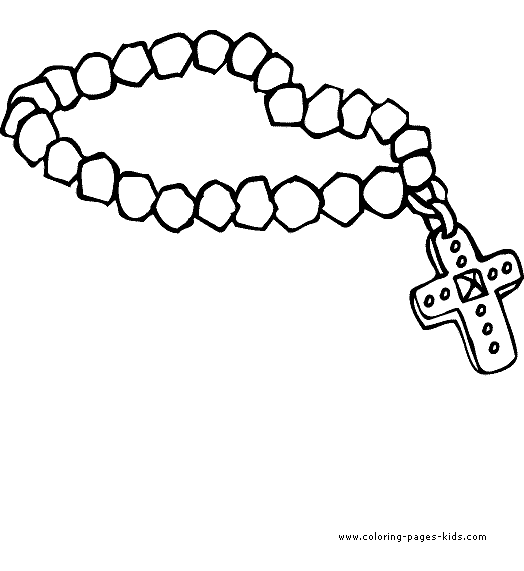
- I use prayer beads
- I get ashed and wear it for the rest of the day
- I plan on reading the Bible in a year in 2016
- I keep a spiritual journal
- I stay overnight and sleep in the church for the Easter Vigil
- I even took a month off work to volunteer in Advent
 To other people, I am obviously religious. I, and others, find it odd if I don't wear a cross, and I get angsty if I miss a Sunday morning for whatever reason. In such a precarious career as freelance theatre stage manager, church is one of the anchors in my life, alongside my family, my boyfriend, and my friends. My aims in life include living by the Great Commandment, and the Golden Rule; being a disciple to Jesus; centering and orientating my life around my relationship with God.
I'm obviously religious. But if you had asked me last year what I identified as, the list would not have included 'religious'. It was only when someone asked me if one of my friends at church was religious that I said "well, yeah, he is, but he only goes to church as much as I do...oh..." and the penny dropped.
I was taken aback. I almost wanted to defend myself against the accusation. And it's this reaction that has made me think about it a bit deeper. Why did I not want to be called 'religious', when it is true? I'm not claiming the "I'm not religious, I'm spiritual" thing, but I would much rather be 'a person of faith'.

'Faith' has a better rep than religion. I think it's definitely a generational thing; there's a feeling of peer pressure to avoid the 'religious' label, and in many ways, a common issue young Christians have is an instinct to hide their religion. Easier to come out as bisexual than Christian! Millennials pride themselves of being progressive, and liberal, and reasonable, and that leads to a rejection of all things seen as not based on reason, including any spirituality or, and especially, a belief in God. Believing in God is often seen as an indication of inferiority, and so going as far as to be religious itself implies an
 irrational adherence to dogma. Modern Western mainstream culture seems to take the view that, alongside gender and race equality, freedom of sexuality, and freedom of speech, the conclusion that there is no God is the obvious, and basically only acceptable, conclusion. It's fashionable to hate religion.
One cannot be religious and considered reasonable, rational, even maybe intelligent. So I think my initial instinct to reject the term comes from a fear that it will class me in the same category as religious fundamentalists, religious nutters, religious terrorists, religious indoctrination, conservatism, creationism, zealots, the judgmental, the out of touch. Calling people religious is often a way of excluding them based on assumptions about their views or behaviour ie. it's a label, so in narrow minds leads to prejudice.
But I am religious. Not because I have been indoctrinated, not because I think everyone should live their lives the way I do, and not because it's easier. I am religious because I practice religion, but I
 practice good religion. Bad religion is exactly what Jesus railed against when arguing with the Pharisees etc. Good religion is a structure, a set of tools to sustain the faith, the relationship with Jesus, God, the universe. The practices, the actions and works are not the important bit, but I need them, flawed human being as I am, to keep up my end of the relationship. I use the combined wisdom of the tradition and scripture to give me a head start, rather than starting at the beginning on my own. I wouldn't get anywhere! It's also a useful motivation to do things that, even though reason and experience tell me I should, I probably wouldn't end up doing if on my own.
This is if I get it right, and I do fail, of course I do. When I fail, my religiosity is just as insubstantial and a distortion as it was when Jesus threw his wobbly in the Temple. And that's where the negativity of 'religious' catches me, and makes me squirm. It's a reminder that though I am aware of good religion, and I try my best, religion gets in my way sometimes, making me no better than the fundamentalists I so desperately do not want to be.
 But my hope is that I get it right enough to outweigh when I get it wrong. I hope I can live a life that is, yes, religious, but in a way that makes people rethink their assumption that being religious is necessarily a negative thing. I find so much that is good, and useful, and wonderful, in religion, and somehow, I hope I can show that to others.
PS a good book to show more of the good in religion than the "religions do good stuff" argument, I recommend Religion for Atheists by Alain de Botton.
- I've identified as Christian since I was 6
- I have worn a crucifix 24/7 since I was 14, so for almost a decade
- I have been going to church every week for over 4 years
- I've been increasingly involved in church life, including
- singing in the choir
- reading the gospel
- being a server
- running the Circus Spirit
- substituting for the cantor
- I pray daily
- I use prayer beads
- I get ashed and wear it for the rest of the day
- I plan on reading the Bible in a year in 2016
- I keep a spiritual journal
- I stay overnight and sleep in the church for the Easter Vigil
- I even took a month off work to volunteer in Advent
I'm obviously religious. But if you had asked me last year what I identified as, the list would not have included 'religious'. It was only when someone asked me if one of my friends at church was religious that I said "well, yeah, he is, but he only goes to church as much as I do...oh..." and the penny dropped.
I was taken aback. I almost wanted to defend myself against the accusation. And it's this reaction that has made me think about it a bit deeper. Why did I not want to be called 'religious', when it is true? I'm not claiming the "I'm not religious, I'm spiritual" thing, but I would much rather be 'a person of faith'.

'Faith' has a better rep than religion. I think it's definitely a generational thing; there's a feeling of peer pressure to avoid the 'religious' label, and in many ways, a common issue young Christians have is an instinct to hide their religion. Easier to come out as bisexual than Christian! Millennials pride themselves of being progressive, and liberal, and reasonable, and that leads to a rejection of all things seen as not based on reason, including any spirituality or, and especially, a belief in God. Believing in God is often seen as an indication of inferiority, and so going as far as to be religious itself implies an

One cannot be religious and considered reasonable, rational, even maybe intelligent. So I think my initial instinct to reject the term comes from a fear that it will class me in the same category as religious fundamentalists, religious nutters, religious terrorists, religious indoctrination, conservatism, creationism, zealots, the judgmental, the out of touch. Calling people religious is often a way of excluding them based on assumptions about their views or behaviour ie. it's a label, so in narrow minds leads to prejudice.
But I am religious. Not because I have been indoctrinated, not because I think everyone should live their lives the way I do, and not because it's easier. I am religious because I practice religion, but I

This is if I get it right, and I do fail, of course I do. When I fail, my religiosity is just as insubstantial and a distortion as it was when Jesus threw his wobbly in the Temple. And that's where the negativity of 'religious' catches me, and makes me squirm. It's a reminder that though I am aware of good religion, and I try my best, religion gets in my way sometimes, making me no better than the fundamentalists I so desperately do not want to be.
But my hope is that I get it right enough to outweigh when I get it wrong. I hope I can live a life that is, yes, religious, but in a way that makes people rethink their assumption that being religious is necessarily a negative thing. I find so much that is good, and useful, and wonderful, in religion, and somehow, I hope I can show that to others.PS a good book to show more of the good in religion than the "religions do good stuff" argument, I recommend Religion for Atheists by Alain de Botton.
Monday, 28 December 2015
Video: Frustration
I had a thought the other day when discussing my next appointment with Lucy, the rector, about how I keep falling into the comforting delusion that the discernment process is trundling along and I'm going to speed along through it.
Nope.
Friday, 27 November 2015
Exploring my doubts
Doubt is not something I want to put words to. Admitting that I have doubts about my calling is quite painful. But doubt is an important part of faith. I don't think a lot of people really realise that. I know for example I've had an argument with my boyfriend about the nature of faith - he thought is was something you feel and not based on evidence. I countered that he was describing blind faith, and I did not recognise his definition as the faith I have.
Blind faith is 100% convinced, but true faith has real conviction because it constantly doubts. Why have faith in something if you haven't reason to? I have doubted pretty much every part of my faith, including the big ones like do I believe in God. I like going back to the very Jewish idea, which I think Anglicanism embraces very well, of arguing. Arguing with your faith, interrogating your scripture, contemplating other possibilities. Moses (Exodus 4) immediately springs to mind as someone who directly shouted at God, questioned God (Exodus 3), and in the New Testment, the Apostle Peter wavered in faith (Matt 14); even Jesus had moments, eg. at the Mount of Olives (Luke 22), and I considered not even mentioning Doubting Thomas as the obvious choice.
These doubters were all true role models of faith. And so I feel stronger for being able to follow their example, and speak out about my doubts, to face them head on, in the never-ending struggle and journey of faith.
I have worried that I am deluded. Most of the time it makes so much sense to think that I am 'destined' to be a priest, then I scold myself for being so arrogant, then I worry that not feeling special is a sign that it's not a true calling, but surely modesty is better than self-grandeur...
It gets a little cyclical, and I end up feeling lost and guilty. Okay, so confront it, what if I am deluded? (Forgetting the possibility of being deluded that there is a God, and concentrating on the possibility of being deluded that I feel a calling from God). I have been getting more and more religious, so is thinking there's a calling just part of my very thorough way of doing things and being a priest seems the obvious way of 'doing religion thoroughly', and that's the real reason I'm doing it? Does it feel right because it feels like the way to do that part of my life 'properly'?

Okay, I might have a calling, but what if I'm called to something else? Being ordained and being a full time priest is just one of many callings for Christians. I might be copping out of the hard reality of juggling Christianity and other parts of my life. Many people, most Christians in fact, live out their faith whilst in full time secular employment, why do I feel I have to put my Christianity as not just my religion but my job, and not just that but a community role, a life vocation?
Surely I'm not the right person to represent the Church and lead an example of Christ-like living. I've never been naturally a 'people person', and a lot of people find me too loud, boisterous, direct and intense. I have very liberal attitudes to things like sex and relationships that many in the Church would probably object to, even though I go about my love life with as much care to Love God as much as Love Neighbour as any other part of my life. But part of me worries that I'm just wrong. I think I'm doing good not evil, that I'm living conscientiously, trying to not sin, but what if I'm wrong? I swear, take Christ's name in vain, get drunk, shout at my family, buy nice things, don't give change to beggars. There are people in the world who genuinely think I'm a bad person; there's at least one I can think of who probably actually hates me. That doesn't sound like a priest.
No one seems as enthusiastic about it as me. Is their support just politeness? There's a lot in the literature about other people affirming your calling - nope. One crazy stranger, that's all I've had. Not my priest, my boyfriend, my family, my friends, no one has positively said they think it's a good idea. I'm not trying to criticise them - if that's how they feel, I certainly want them to be honest. So if they are, if I'm in the minority of one that thinks I could be a priest, how likely is it that I'm the one that's right?
Let's look at the Criteria again (see also previous post) and what I can't do or haven't got.
So what do I doubt about my calling? I doubt that I'm called at all, I doubt that I'm called specifically to be ordained, I doubt that I'm the right type of person to be ordained, I doubt that I'm right to disagree with my support network, I doubt that I can fit the criteria for being ordained.
 And it is terrifying. I hate having doubts. I have so much conviction, assurance and excitement about my calling, it knocks at my core to express doubt. I've used this metaphor before: I have a bedrock of trust in God, on which are pillars of faith, holding up the foundations of my soul, on which the building of my heart sits, in the infusing cloud of my brain. Doubt is lightning spearing from that cloud, and rocking the whole structure. My emotions get knocked about and chaotic, my soul ripples and sends shockwaves through my faith, and my trust is holding firm but not unwobbled.
If you want to read the positive side of this argument with myself, read the post Reasons I think I'd make a good priest/want to be priest.
 |
| Faith is not always blind |
These doubters were all true role models of faith. And so I feel stronger for being able to follow their example, and speak out about my doubts, to face them head on, in the never-ending struggle and journey of faith.
***
It gets a little cyclical, and I end up feeling lost and guilty. Okay, so confront it, what if I am deluded? (Forgetting the possibility of being deluded that there is a God, and concentrating on the possibility of being deluded that I feel a calling from God). I have been getting more and more religious, so is thinking there's a calling just part of my very thorough way of doing things and being a priest seems the obvious way of 'doing religion thoroughly', and that's the real reason I'm doing it? Does it feel right because it feels like the way to do that part of my life 'properly'?
Okay, I might have a calling, but what if I'm called to something else? Being ordained and being a full time priest is just one of many callings for Christians. I might be copping out of the hard reality of juggling Christianity and other parts of my life. Many people, most Christians in fact, live out their faith whilst in full time secular employment, why do I feel I have to put my Christianity as not just my religion but my job, and not just that but a community role, a life vocation?
Surely I'm not the right person to represent the Church and lead an example of Christ-like living. I've never been naturally a 'people person', and a lot of people find me too loud, boisterous, direct and intense. I have very liberal attitudes to things like sex and relationships that many in the Church would probably object to, even though I go about my love life with as much care to Love God as much as Love Neighbour as any other part of my life. But part of me worries that I'm just wrong. I think I'm doing good not evil, that I'm living conscientiously, trying to not sin, but what if I'm wrong? I swear, take Christ's name in vain, get drunk, shout at my family, buy nice things, don't give change to beggars. There are people in the world who genuinely think I'm a bad person; there's at least one I can think of who probably actually hates me. That doesn't sound like a priest.
No one seems as enthusiastic about it as me. Is their support just politeness? There's a lot in the literature about other people affirming your calling - nope. One crazy stranger, that's all I've had. Not my priest, my boyfriend, my family, my friends, no one has positively said they think it's a good idea. I'm not trying to criticise them - if that's how they feel, I certainly want them to be honest. So if they are, if I'm in the minority of one that thinks I could be a priest, how likely is it that I'm the one that's right?
 |
| I have no issues with my human sexuality |
Let's look at the Criteria again (see also previous post) and what I can't do or haven't got.
- Others have not confirmed my inner conviction.
- I have barely any spirituality; I generally never sit in prayer to God apart from reading other people's words. Nor have I done any Bible study. I don't see how the world and others have been affected my practice of prayer, and frankly I have serious issues with the notion of 'the power of prayer'. I've never understood how spiritual practice 'sustains and energises'.
- I've struggled with maintaining appropriateness in professional relationships - I'm a flirt, blunt, emotional. I'm an out bisexual - whoops, Issues of Human Sexuality.
- People don't follow me, my leadership skills leave a lot to be desired. How can I offer an example of faith when I feel culturally compelled to not mention God so as not to make atheists uncomfortable?
- I feel anger and fear about mission, a distinct mistrust and aversion to evangelising.
***
So what do I doubt about my calling? I doubt that I'm called at all, I doubt that I'm called specifically to be ordained, I doubt that I'm the right type of person to be ordained, I doubt that I'm right to disagree with my support network, I doubt that I can fit the criteria for being ordained.
And it is terrifying. I hate having doubts. I have so much conviction, assurance and excitement about my calling, it knocks at my core to express doubt. I've used this metaphor before: I have a bedrock of trust in God, on which are pillars of faith, holding up the foundations of my soul, on which the building of my heart sits, in the infusing cloud of my brain. Doubt is lightning spearing from that cloud, and rocking the whole structure. My emotions get knocked about and chaotic, my soul ripples and sends shockwaves through my faith, and my trust is holding firm but not unwobbled.
***
If you want to read the positive side of this argument with myself, read the post Reasons I think I'd make a good priest/want to be priest.
Subscribe to:
Posts (Atom)